
Whale Watching in Dana Point in April: A Local’s Guide to Gray Whale Calves and the Fin Whale Surge
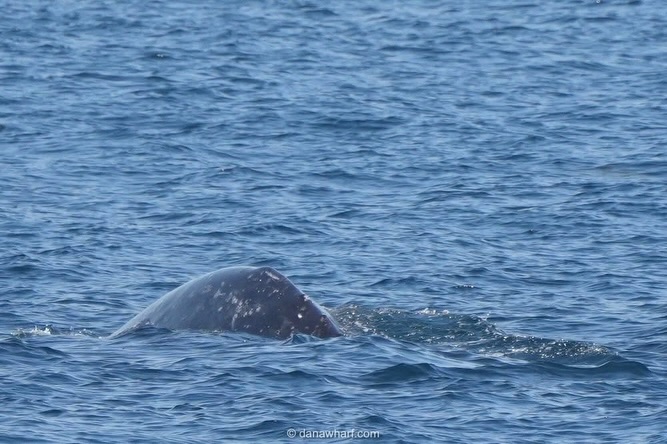
April is the month the gray whales stop being a migration and start being a family. The single adults and juveniles have mostly cleared out by now. What is left coming up the coast are mothers and calves, moving slowly, hugging the sand, in no particular hurry to be anywhere.
It is also, quietly, the best fin whale month we get. Last April we had days where our trips found six of them. That is not a normal number for the second largest animal on the planet.
Here is what April actually looks like from the rail, what our boats logged last season, and how to plan a trip around it.
What Makes April Different From March and May?
March is the peak of the northbound gray whale migration. The volume is high and the whales are moving. We covered that month in our March whale watching guide.
April trades volume for quality. There are fewer gray whales going past than there were in March, but a much higher share of the ones you do find are cow and calf pairs. Those are the ones people remember.
May is when the gray whales taper off for good and the blue whales take over as the headline. Our May guide covers that handoff.
April sits in the middle and gets a bit of everything. It is the only month of the year where you have a real shot at a gray whale calf in fifteen feet of water and a blue whale a few miles offshore inside the same four weeks. Not on the same trip, usually. But the same month, absolutely.
Will You See a Gray Whale Calf in April?
This is the best month of the year for it, and here is the honest version of why.
Gray whale calves are born in the Baja lagoons from roughly early January through mid-February. NOAA Fisheries puts a newborn at 14 to 16 feet long and about 2,000 pounds, which is a substantial animal to call a baby. Mothers stay in the lagoons while the calves put on weight and strength, then start north later than everyone else and travel slower once they go.
That lag is the whole story. NOAA has the northbound migration running mid-February through May. The single adults come through first, in February and March. The cow and calf pairs bring up the rear, which lands them off Dana Point through April and into early May.
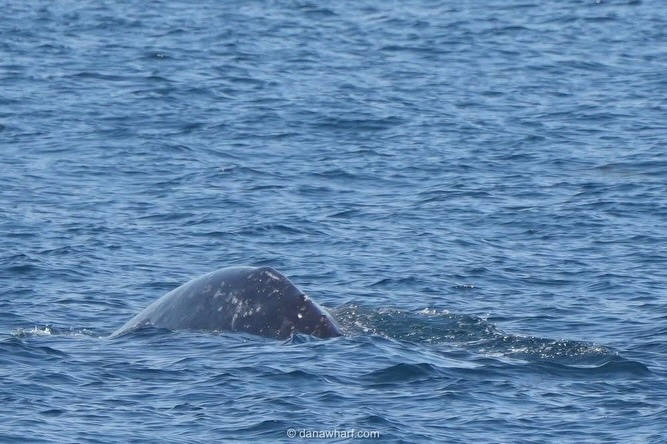
They also come in absurdly close. A mother with a calf sticks to the shallows on purpose, because deep open water is where the trouble is. Last April our boats found a gray whale cow and calf cruising in about fifteen feet of water right off the Dana Point Headlands, and another pair working past the Headlands a day later with the calf popping up and splashing around the whole way.
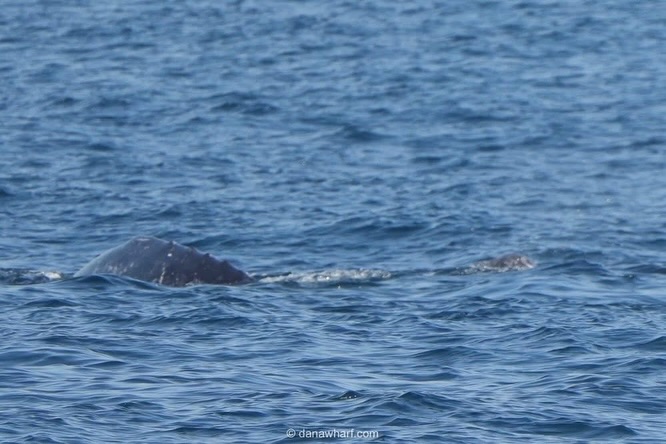
If a baby gray whale is the reason you are booking, April is your month. Read our guide to cow and calf season before you come so you know what you are looking at.
Why Is April Such a Big Fin Whale Month?
Ask most people to name the second largest animal on Earth and they will guess wrong. It is the fin whale, and off Dana Point in April they are everywhere.
NOAA lists fin whales at 75 to 85 feet and 40 to 80 tons. They are lunge feeders that gulp krill, small schooling fish and squid through 50 to 100 throat pleats, and they put away up to two tons of food a day. They are also fast, sleek, and built completely differently from a gray whale. Where a gray whale is mottled and barnacled and unhurried, a fin whale is smooth dark gray with a tall curved dorsal fin set way back toward the tail, and it moves like it has somewhere to be.
What brings them here in April is food. The upwelling that kicks off along our coast in spring loads the water column with krill along the underwater canyon edges a few miles out. Fin whales are deep water animals most of the year, and in April they come in to eat.
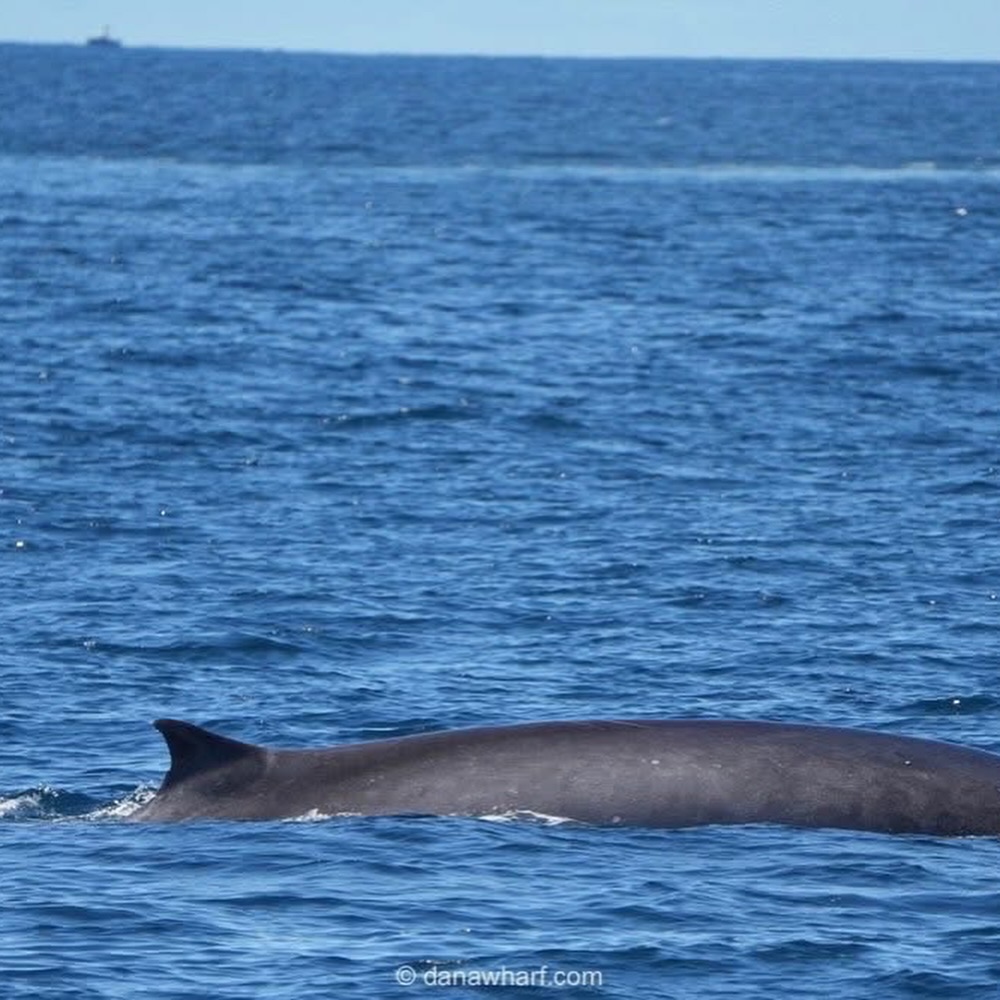
The catch is that fin whales rarely lift their flukes, so plenty of guests do not fully register what they just watched. When a naturalist tells you that animal is 80 feet long, believe them. Our full breakdown is in everything you need to know about fin whales.
What Did We Actually See Last April?
Monthly averages are useless when you are trying to pick a day. Here are real trips off our boats last April.
- April 3: six northbound gray whale sightings across the day, all of them close to shore.
- April 5: at least six fin whales, a loggerhead sea turtle, common dolphin and a mola mola.
- April 6: at least six fin whales again, bottlenose and common dolphin, and two mola mola.
- April 12: three fin whales, a gray whale, bottlenose and common dolphin, and a yellow snake eel.
- April 13: a fin whale actively feeding seven miles south of the harbor, plus bottlenose and common dolphin.
- April 15: a gray whale cow and calf in about fifteen feet of water off the Headlands.
- April 19: two gray whales as a cow and calf pair, three or more fin whales, and common dolphin.
- April 20: two fin whales, a humpback whale, and common dolphin.
- April 26: three fin whales, a minke whale, and common dolphin.
- April 27: six fin whales, one of our best single days of the spring.
Not every day looks like that. Anyone who tells you the ocean runs on a schedule has not spent enough time on it. But those are honest ceilings from a real month, and they explain why our April calendar fills the way it does.
When Do the First Blue Whales Show Up?
Late April, if we get lucky. Last season our first blue whale sighting of the year landed on April 21, right around Earth Day.
That is early. Blue whale season here really belongs to summer, and by June they are a reliable find rather than a lottery ticket. But the krill blooms that pull them in start in spring, and every few years the first one shows up while the gray whale calves are still going past.
For scale, NOAA has blue whales reaching up to 110 feet and 330,000 pounds, with the biggest individuals eating around six tons of krill a day. They are the largest animals known to have ever lived. If you want the full picture of when and where to find them, we wrote where can you see blue whales.
Do not book an April trip expecting a blue whale. Book it expecting gray whale calves and fin whales, and treat a blue as the bonus it is.
What Else Is Out There in April?
Humpbacks. They used to be a summer animal here and now they turn up most of the year. We had one in with a pair of fin whales on April 20 last season. A humpback will out-perform almost anything else at the surface.
Minke whales. The smallest baleen whale in North American waters at around 35 feet, shy and quick. NOAA notes they surface snout-first with a small bushy blow and do not raise their flukes when they dive, which is exactly how you tell one from everything else out there.
Dolphin. Common dolphin are on essentially every April trip, often in the hundreds, and the megapods that run into the thousands can show up any month. Bottlenose work the surf line closer in. Our guide to dolphin megapods covers what to watch for.
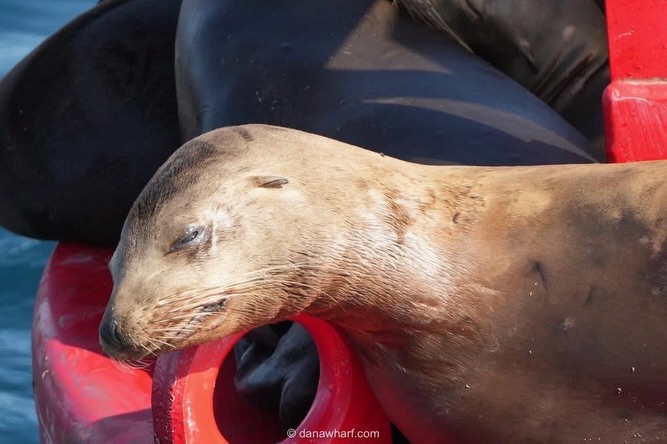
The rest of it. Sea lions piled on the navigational buoys, mola mola sunfish, loggerhead sea turtles, and enough seabird activity that our naturalists keep binoculars up the entire trip. Last April we even logged a yellow snake eel, which is not something we can promise you twice.
How Is the Gray Whale Population Doing?
This comes up on the bow almost every spring trip, and it deserves a straight answer.
The eastern North Pacific gray whale came off the Endangered Species list in 1994 after recovering from commercial whaling, and it stays protected under the Marine Mammal Protection Act. Then numbers dropped hard during an Unusual Mortality Event that ran from 2019 through 2023, and reproduction has stayed weak since. NOAA’s 2025 calf estimate came in at 85, the lowest in a record that goes back to 1994.
Abundance moved the other way. NOAA Fisheries put the 2025/2026 population between 15,930 and 20,530 whales, averaging around 17,750, up from a 2024/2025 range of roughly 11,700 to 14,200. NOAA is careful to note that a jump that size is larger than reproduction alone could explain, so it may reflect survey conditions or shifts in whale behavior rather than a real surge.
These are trend lines with wide error bars, not headcounts. What we can tell you is what came past the boat, and last April the calves were there.
What Should You Wear on an April Whale Watch?
April is the month people get this wrong most often, because the parking lot lies to you. It will be genuinely warm at the harbor and meaningfully colder two miles out with the boat underway and wind coming over the bow.
Layers, a windbreaker, and closed toe shoes. A beanie is not overkill on the morning trips. Spring sun off the water is stronger than it feels, so sunglasses and sunscreen still apply. The full rundown is in what to wear whale watching.
April can also bring an afternoon breeze and some leftover spring swell. If you are prone to motion sickness, take something before you board rather than after you start feeling it. Our captains put their notes together in avoiding seasickness.
When Should You Book an April Trip?
Any week in April works, but the middle of the month has historically been our sweet spot for cow and calf pairs close to the beach.
Mornings usually give you the calmest water and the cleanest light, which matters if you are shooting photos. Afternoons have a habit of surprising people. If you want to come home with something worth printing, we put together how to photograph whales with our captains.
Weekdays beat weekends for elbow room, and Half Price Tuesdays make a midweek April trip the best value on our calendar. Bringing small kids? Our Wyland Whale and Dolphin Adventure art lesson runs Saturday mornings at 9am before the 10am departure, and our parent’s guide to whale watching with kids handles the rest.
Every one of our whale watching tours carries our sighting guarantee. If the captain decides you did not get a satisfactory showing of whales or dolphins, you get a Whale Check for a free return trip, and it never expires. We do not control the ocean, so we would rather you come back.
If you want to see how April stacks up against the rest of the year, our month-by-month guide lays out all twelve.
The calves are going past right now, and they are doing it close enough to the beach that you barely have to leave the harbor. Come see them off.