
Whale Watching in Dana Point in January: A Local’s Guide to Peak Gray Whale Season
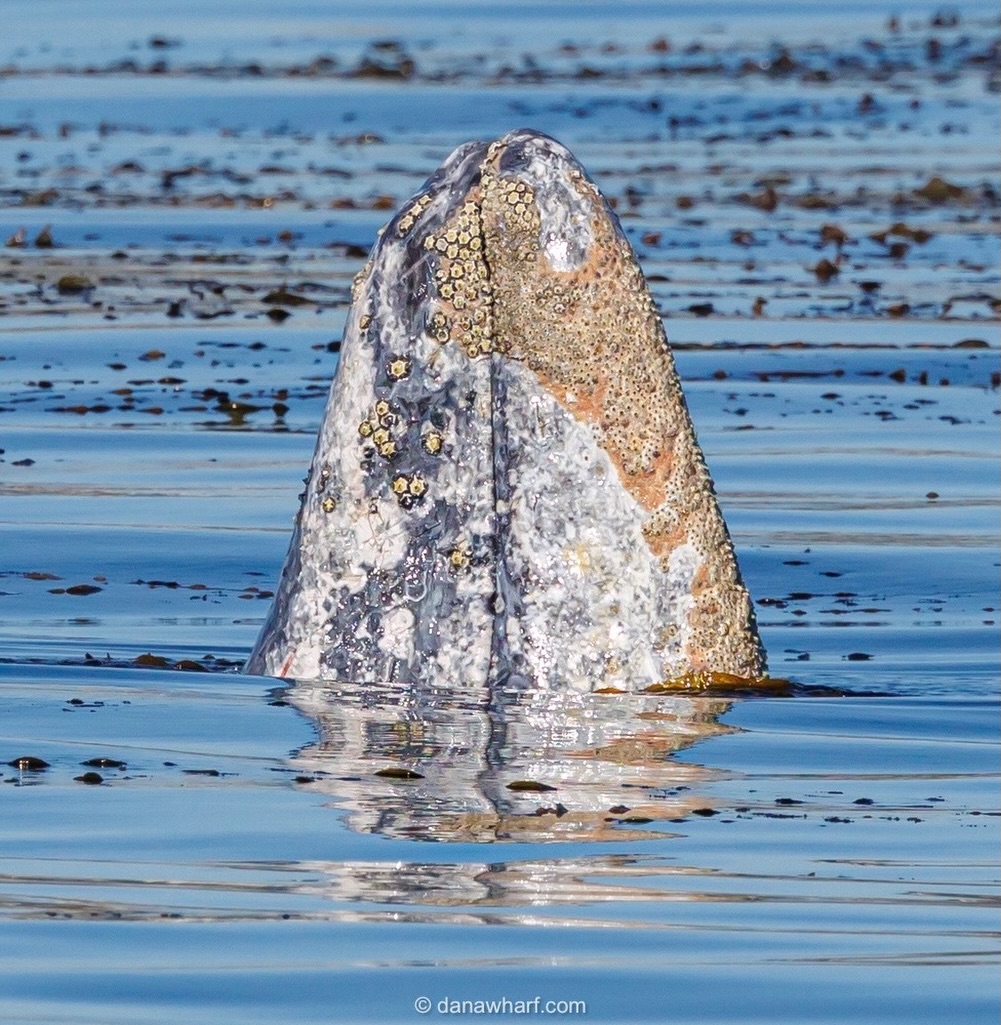
There is a stretch of ocean off the Dana Point Headlands where, on a good January morning, you can watch a heart-shaped blow go up, then another a half mile past it, then a third off the bow, and realize you have lost count of how many gray whales are in your two hours on the water. That is January in Dana Point. The trickle we wrote about in our December guide has become a highway.
December is when the gray whale migration wakes up. January is when it hits full stride. The southbound run down the coast peaks this month, and Dana Point sits on one of the best seats in the house for it. The whales are close, the counts are high, and the boats are not crowded because most people assume whale watching is a summer thing. It is not. This is the single best month of the year to see a gray whale off Southern California.
Here is what actually happens off Dana Point Harbor in January, from the people who run these boats every day of it.
What Whales Can You See in Dana Point in January?
January is a gray whale month first, but it is not a one-species month. On any given trip you have a real shot at:
- Gray whales. The main event. Southbound animals headed for the lagoons of Baja California, passing close to shore, often within a mile or two of the beach.
- Fin whales. The second-largest animal on Earth and one of the most reliable whales off this coast in any month, January included.
- Humpback whales. Fewer than in the fall, but some winters a handful hang around, and they are still the species most likely to breach on you.
- Minke whales. Small, shy, and here year-round. Our captains find them more often than most people expect.
- Dolphins, nearly every trip. Common dolphin in the hundreds and often the thousands, plus bottlenose and the occasional Risso’s. Winter megapods are some of the biggest of the year.
The one species that is gone is the blue whale. The giants that feed here through July and August are deep into their own migration by January. If a blue whale is on your list, come back in summer. For everything else, this is prime time.
Why Is January the Peak of Gray Whale Season?
Because the whole population is on the move at once, and it is moving past us.
The gray whale migration works in waves. The first animals south, usually in December, are scouts, older males and females without calves. The bulk of the run, the pregnant females racing to give birth in Baja, comes right behind them, and that main wave peaks off Southern California in January. That is why the water off the Headlands can feel busy this month in a way it never does in December. You are not watching a straggler here and there. You are watching the migration at its densest.
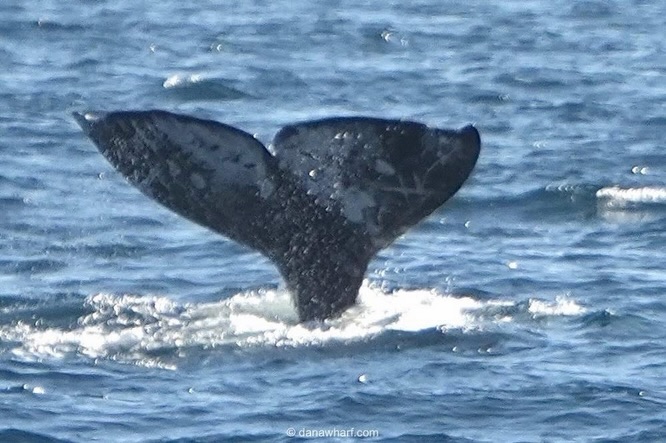
Last season, our first southbound gray showed up in mid-December, and by early January we were finding them on nearly every trip. By the middle of the month the boats were coming back having logged five, seven, even nine grays in a single day. That is the January pattern almost every year: December is a hunt, January is a rhythm.
Geography is why it works. Gray whales are running a route between the Arctic and Baja, and Dana Point sits on a stretch of coast where deep water comes in close. The whales do not have to detour around us, they come right past the Headlands, often between one and three miles off the beach. That is a big part of why Dana Point carries the Dolphin and Whale Watching Capital of the World® title, and why we can put you on gray whales in a two-hour trip instead of a half-day run offshore. If you want the whole year laid out at once, our month-by-month whale watching guide covers what shows up when, and our post on what whales we see in the new year is a good companion to this one.
How Far Do Gray Whales Travel to Get Here?
This is the number that stops conversations on the boat. According to NOAA Fisheries, gray whales cover roughly 10,000 to 12,000 miles round-trip on their annual migration, one of the longest of any mammal on Earth. The southbound half of that is the leg you are watching in January.
They are not stopping to feed on the way down. They fed all summer in the Arctic and they are burning through that reserve to reach the shallow, warm, salty lagoons of Baja California where the calves are born. NOAA puts the birthing window at early January through mid-February, which means the animals passing Dana Point right now are pregnant females on a deadline and everyone else trying to keep pace. Some of the very first calves of the year are being born in Baja while the tail of the migration is still sliding past our Headlands.
Adults run about 40 to 50 feet and weigh in around 90,000 pounds. Up close, the thing people always comment on is the skin. Gray whales carry barnacles and whale lice, concentrated on the head and tail, which is why they look mottled and crusted rather than sleek. Every one of those patterns is different, which is how researchers tell individuals apart. If you want the full profile on the species before you come out, we wrote a complete gray whale guide, and our post on the best time to see gray whales in Southern California backs up why January earns the top spot.
How Many Gray Whales Are Left?
More than there were a century ago, and that recent story is worth knowing before you come down.
Eastern North Pacific gray whales were hunted to the brink, recovered, and were removed from the Endangered Species Act list in 1994. That is one of the genuine conservation wins in marine mammal history. But the population took a hard hit during a recent Unusual Mortality Event, dropping to some of its lowest counts since surveys began in the late 1960s. NOAA Fisheries’ most recent estimate puts the population back up around 17,750 animals, with a range of roughly 15,930 to 20,530. Researchers are careful to note that a jump that size likely exceeds what the population could actually reproduce in a year, so some of it reflects survey variation rather than pure growth.
Calf production is still the worry. NOAA’s 2025 estimate came in at about 85 calves, the lowest in the entire time series. We tell guests this because it changes how the trip feels. You are not looking at a sure thing that will always be here. You are looking at a population that has come back from commercial whaling once already and is working through another rough stretch. Every fluke you see off the Headlands in January counts for something.
Are Fin Whales, Humpbacks, and Dolphins Around in January Too?
Very much so, and this is the part people underestimate about a winter trip.
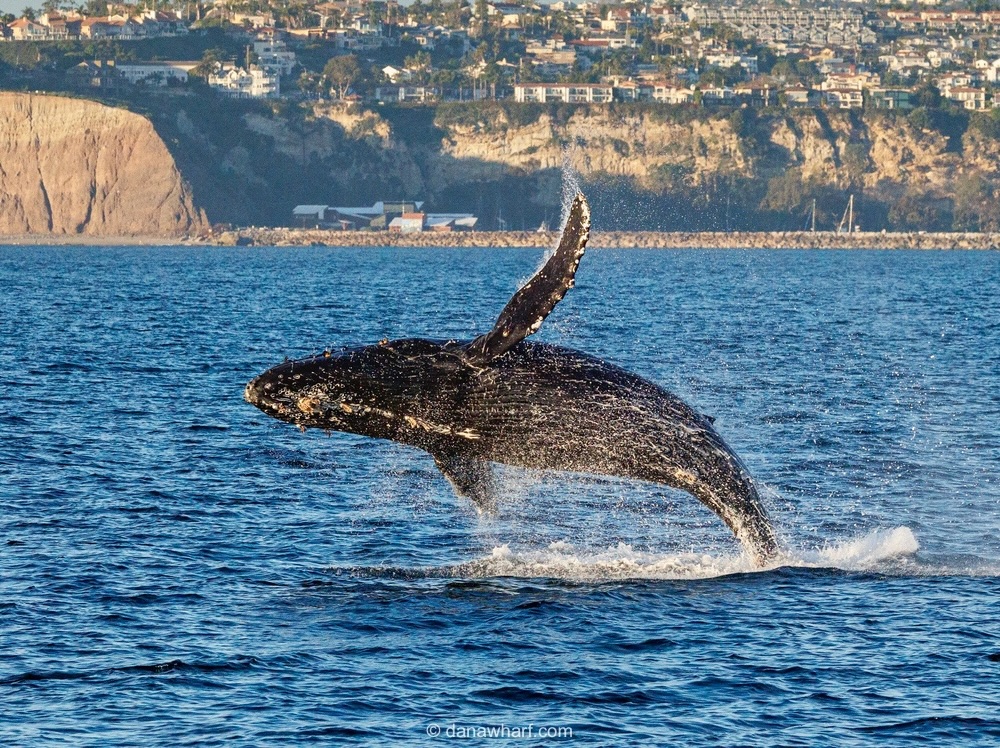
Fin whales are the quiet reliable ones. The second-largest animal on the planet, and we find them off this coast all winter, often surprisingly close to the harbor. Humpbacks are less predictable in January than they are in fall, but when one decides to put on a show, it throws its flukes straight up before a deep dive, slaps those long pectoral fins on the surface, and every so often launches its whole body clear of the water. If you want to tell a humpback from the grays you came for, our gray whale versus humpback breakdown is the cheat sheet.
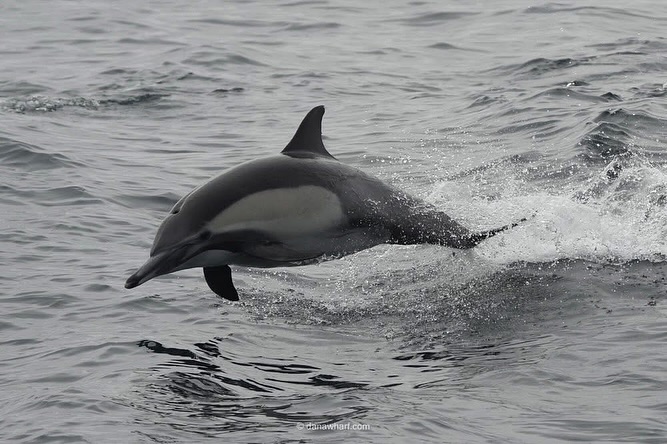
The dolphins, though, are the reason nobody comes back from a January trip empty. Common dolphin megapods off Dana Point can run into the thousands, and when a pod that size decides to run with the boat, the water goes white for a hundred yards in every direction. Our guide to dolphin megapods covers when and why they get that big.
This mix is also why our Whale Check guarantee works the way it does. If you do not see a whale or a good showing of dolphins on your trip, you get a return ticket. In January, we hand out very few of them.
What Is a January Whale Watch Actually Like?
Cold, is the short version, and not in the way people expect.
Onshore in Dana Point, January runs in the low-to-mid 60s and looks like a perfectly nice day. The second you clear the jetty and the boat gets moving, the wind chill takes about ten degrees off that, and if it is overcast you will feel every bit of it. We watch people board in a T-shirt from the parking lot and spend the whole trip inside the cabin regretting it. Dress for it and you get the best whale watching of the year: layers, a windbreaker on top, closed-toe shoes, and a hat. Our season-by-season guide to what to wear has the full breakdown.
Winter also brings bigger swell than summer does, so if you are prone to motion sickness, read our captains’ seasickness prevention tips before you come down, not after. The upside of a January weekday is space. The summer crowds are gone, the boats are not packed, and you can move around the rail to whichever side the whale surfaces on. Morning trips tend to have the calmest water, though grays surface all day and we find them on the afternoon runs just as often.
Is January a Good Time to Go Whale Watching in Dana Point?
It is the best month of the year for gray whales, and one of the most underbooked good months we have.
Here is the case. You get gray whales at the absolute peak of their migration, passing our Headlands close enough to photograph from a two-hour trip. You get fin whales, the odd humpback, and minkes still in the neighborhood. You get the biggest dolphin pods of the year. You get open decks, short lines, and captains who have been finding whales on this stretch of coast for over fifty years. And you get to watch the migration at its densest, before the crowds show up for the northbound run in spring.
If you are planning ahead, the northbound half of this migration is a completely different trip, with mothers and calves hugging the shore on their way back to the Arctic. Our post on cow and calf season covers what that looks like, and the great turnaround explains the strange window when southbound and northbound whales pass each other off the same beach.
Come see the peak. Our whale watching trips run daily out of Dana Point Harbor, all ages, two hours on the water. If you are coming up from the south, we also run whale watching out of Oceanside. Book a January morning, dress warmer than you think you need to, and get out there before the next blow goes up without you.