
Whale Watching in Dana Point in February: A Local’s Guide to Two Migrations at Once
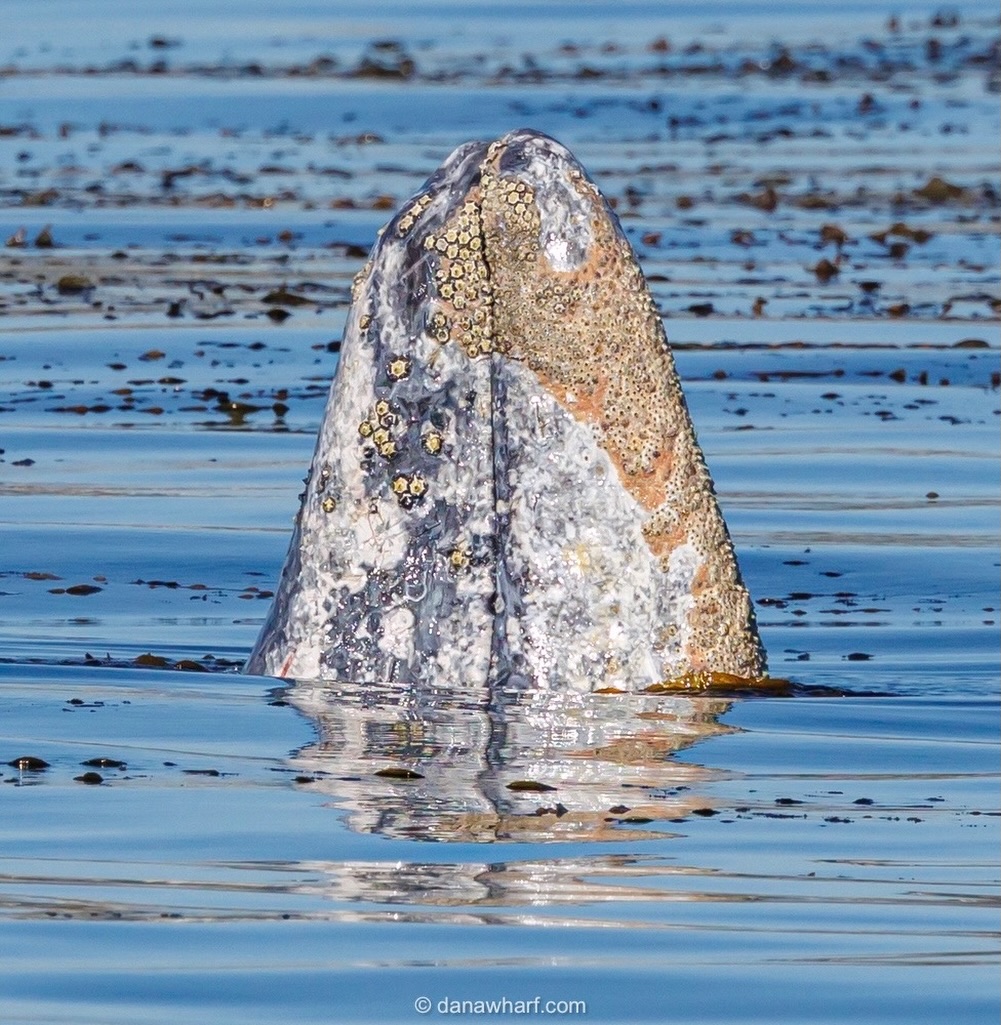
There is one month a year when we can leave Dana Point Harbor in the morning, find a gray whale swimming south toward Mexico, and then find another one a few hours later swimming north toward Alaska. That month is February.
Most people book a whale watching trip in January because that is when they hear the migration is peaking. They are not wrong. But February is the month the migration doubles back on itself, and if you know what you are looking at, it is the most interesting four weeks of the whole gray whale season off this coast.
Here is what we actually see in February, what the water and the weather are doing, and how to plan a trip so you get the most out of it.
What Makes February Different From January?
January is a one way street. Nearly every gray whale that passes Dana Point in January is southbound, running down the coast toward the calving lagoons in Baja California. It is a steady, purposeful parade, and it is a great time to be on the water. We wrote up the whole month in our January whale watching guide.
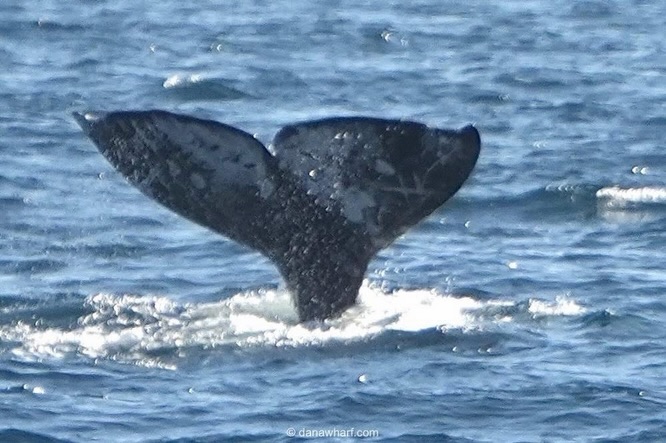
February is a two way street. According to NOAA Fisheries, the northbound gray whale migration runs from mid-February through May. The southbound push is winding down at the same time. So for a few weeks the two streams overlap, and the whales passing our coast are not all going the same direction.
You can watch this happen in our own trip logs. On February 10th last season we spotted our first northbound gray whale blows right off the Dana Point Headlands. Two weeks later, on the first of March, we were still finding southbound grays about two miles below the harbor. Same coastline, same month, opposite directions.
That is not a technicality. A southbound whale is traveling light and moving with purpose. A northbound whale has already done the hard part and tends to travel closer to shore, which usually means a better look from the rail.
Why Do Gray Whales Pass Dana Point Twice?
Gray whales make one of the longest migrations of any mammal on earth. NOAA Fisheries puts the round trip at roughly 10,000 miles, with some individuals covering upwards of 14,000. They spend the summer feeding in the Arctic, then run the length of the West Coast to three shallow lagoons on the Pacific side of Baja California: Laguna Ojo de Liebre (also known as Scammon’s Lagoon), San Ignacio, and Magdalena Bay.
Those lagoons are where the calves are born, generally from early January through mid-February. Warm, shallow, protected water is a much better place to be a newborn whale than the open Pacific. Once the calves are strong enough, the mothers turn around and start the trip back north.
Dana Point sits almost exactly halfway along that route. Every gray whale making the journey has to pass us, and thanks to the way the coastline and the Catalina Channel are shaped, a lot of them pass close. That is a big part of why Dana Point is the Dolphin and Whale Watching Capital of the World.
These are big animals to have that close. NOAA lists adult gray whales at 42 to 49 feet and about 90,000 pounds. They feed by rolling onto their sides and plowing along the bottom, filtering small invertebrates like amphipods through 130 to 180 coarse baleen plates on each side of the jaw. It is a completely different feeding style from the lunging humpbacks we see in summer, and it is why a gray whale’s head is so often crusted with barnacles.
What Did We Actually See Last February?
Rather than give you a range of averages, here are real days off our boats last February.
- February 14: two humpback whales and seven gray whales. Nine whales, all different animals, in a single day.
- February 17: seven northbound gray whales and a humpback.
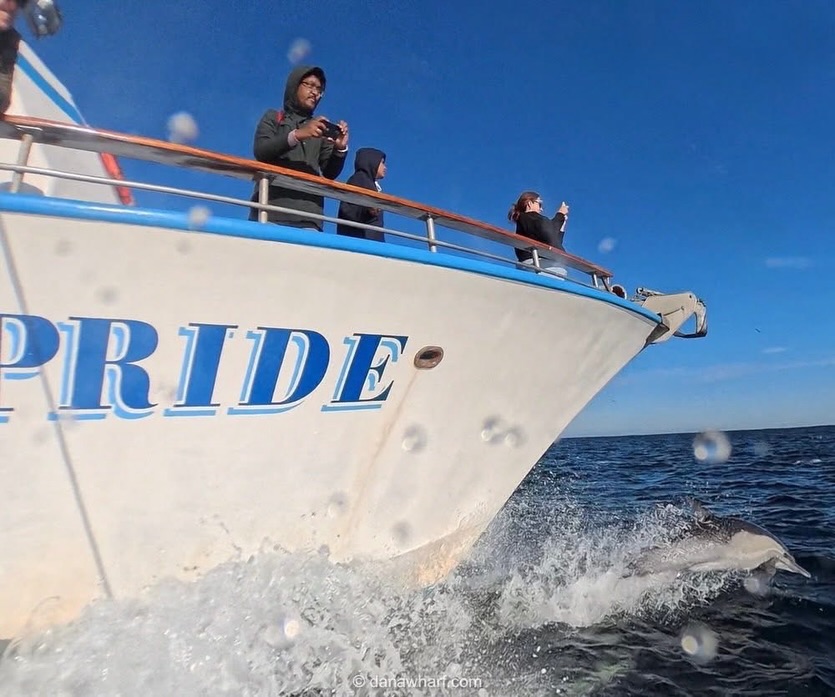
- February 23: one humpback, four gray whales and common dolphin, with snow on the mountains behind the harbor.
- February 24: a group of five gray whales traveling together.
That is a good February. Not every day looks like that, and anyone who promises you otherwise has not spent much time on the water. But it gives you an honest sense of the ceiling, and it explains why we like this month so much.
One thing worth flagging: February is usually too early for the northbound mothers and calves. Those pairs travel slower and later, and they build through March into April and May, hugging the shoreline to keep the calves out of deep water. If seeing a baby gray whale is the whole point of your trip, read our guide to cow and calf season and aim for spring instead.
What Else Is Out There in February?
Gray whales get top billing, but they are not the only thing we find.
Humpbacks. They used to be a summer animal here. Over the last several seasons we have been seeing them through the winter too, and a February humpback often puts on a better surface show than the grays do. If you want to tell them apart before you get on the boat, we broke it down in gray whale vs. humpback whale.
Fin whales. The second largest animal on the planet, and a regular here in winter. They are fast, they are enormous, and they do not fluke, so people often do not realize what they just saw.
Dolphin. Common dolphin are here essentially every trip, sometimes in the hundreds. Bottlenose work the surf line closer in. Winter dolphin numbers off Dana Point are the reason this stretch of coast got its name in the first place.
February also happens to have some of the clearest air of the year. The days after a storm are the ones we look forward to, when you can see Catalina and San Clemente Island from the rail and there is snow visible on the mountains behind the harbor.
How Is the Gray Whale Population Doing?
This is the question we get most often on the bow in winter, and the honest answer is that it has been a rough stretch with some recent good news.
The eastern North Pacific gray whale population was taken off the Endangered Species list in 1994 after recovering from commercial whaling, and it remains protected under the Marine Mammal Protection Act. Numbers dropped sharply during an Unusual Mortality Event that ran from 2019 through 2023, and calf production has stayed low since. NOAA’s 2025 calf estimate was just 85, the lowest on record.
The abundance count went the other way. In July 2026 NOAA Fisheries put the 2025/2026 population at somewhere between 15,930 and 20,530 whales, averaging around 17,750, up from an average of about 12,890 the year before. NOAA itself notes that a jump that size likely exceeds what the population could produce through reproduction alone, so it may reflect changes in survey conditions or whale behavior rather than a true surge. These estimates carry real margins of error and are most useful as a trend line, not a headcount.
What we can tell you is what we see from the boat, and last winter we saw plenty of them.
What Should You Wear on a February Whale Watch?
This is the thing people get wrong most often. It will be 70 degrees and sunny in the parking lot and it will be considerably colder two miles offshore with the boat moving. Every February we watch someone shiver through an otherwise perfect trip because they trusted the forecast on their phone.
Layers, a windbreaker, and closed toe shoes. Bring a beanie. The sun is stronger on the water than it looks in winter, so sunglasses and sunscreen still apply. Our full breakdown is in what to wear whale watching.
Winter swell is also a real thing. If you are prone to motion sickness, take something before you board rather than after you feel it, and read our captains’ advice on avoiding seasickness.
When Should You Book a February Trip?
Mid-February onward, if you want the best odds of catching both directions of the migration in one outing. The northbound whales start showing up around the middle of the month and the southbound stragglers are still coming through.
Weekdays are quieter than weekends, and the first trip of the day usually has the calmest water. Presidents Day weekend is our busiest stretch of the month, so book ahead if that is your window. If you are bringing small kids, our Saturday morning art lesson runs before the 10am trip, and our parent’s guide to whale watching with kids covers the rest.

One more thing worth putting on your calendar: the Festival of Whales takes over Dana Point every March, and the 56th annual celebration runs March 5 through 7, 2027. February is a good month to go if you want the whales without the crowds.
Every one of our whale watching tours is backed by our sighting guarantee. If the captain decides you did not get a satisfactory showing, you get a Whale Check, good for a free return trip, and it never expires. We are not going to pretend the ocean is predictable, so we would rather have you come back.
If you want to see how February stacks up against the rest of the calendar, our month-by-month guide lays out the whole year.
Come see them while they are going both ways. It only happens once a year.