
The Legend of the Deep: How to Find the Elusive Sperm Whale

Of all the creatures we search for off the coast of Dana Point, none carries quite the same legendary status as the Sperm Whale. Immortalized as “Moby Dick,” this is the largest toothed predator on the planet.
While we see Gray Whales by the thousands and Blue Whales by the hundreds, the Sperm Whale remains a mysterious visitor. They are the “Holy Grail” for many of our captains and naturalists.
So, how do you catch a glimpse of one? And when is the best time to try?
The “Migration” Myth Unlike the Gray Whales, which are currently commuting on a strict schedule between Alaska and Mexico, Sperm Whales are roamers. They don’t follow a simple north-south highway.
Instead, they follow the food. Sperm Whales feed primarily on deep-water squid. Because they hunt in the pitch-black depths (sometimes diving over 3,000 feet!), they go wherever the squid are plentiful. This makes their movements much harder to predict than our other whale species.
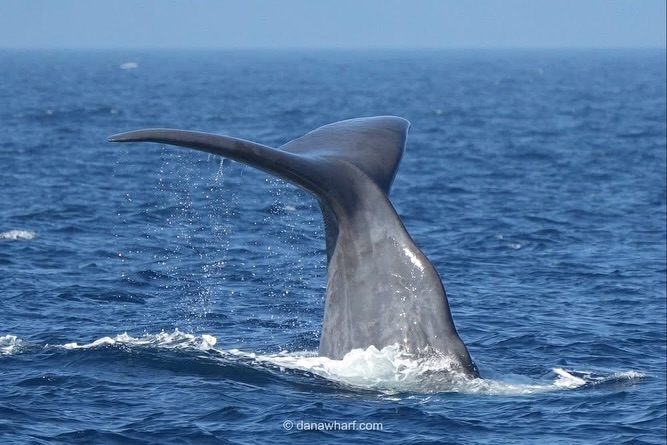
When is the Best Chance to See Them? While Sperm Whales can theoretically appear in Southern California year-round, historical data suggests a pattern.
The Fall Window (September – November) In recent years, many of our most spectacular Sperm Whale sightings have occurred in the late fall. As the water cools slightly and ocean currents shift, we sometimes see an influx of squid that brings these giants closer to the coast.
The “Deep Water” Factor Sperm Whales are deep divers. They prefer the abyssal canyons and drop-offs.
-
Tip: Your odds of seeing a Sperm Whale often increase on longer trips (like our 8-hour adventures or special charters) that travel further offshore than the standard 2-hour coastal cruise.
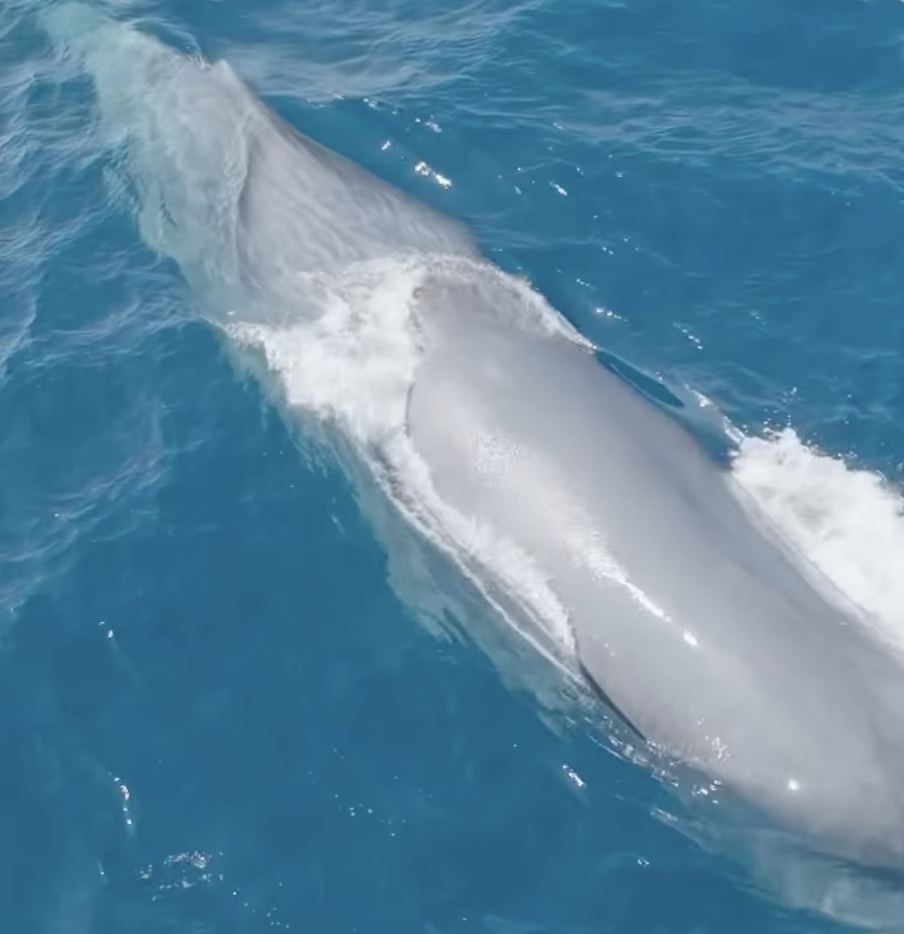
How to Spot Them: The “45-Degree” Clue Identifying a Sperm Whale is distinct from any other whale.
-
The Blow: This is the biggest giveaway. A Sperm Whale’s blowhole is located on the left side of its head, not the top. When they exhale, the spray shoots out at a sharp 45-degree angle to the left. If you see a crooked blow on the horizon, tell the crew immediately!
-
The “Log”: On the surface, they look like massive, wrinkled logs. Their skin has a prune-like texture, very different from the smooth skin of a Blue or Fin Whale.
-
The Dive: When they go down, they go down for a long time. A Sperm Whale can hold its breath for 45 to 60 minutes. If we spot one, we have to be patient!
Why It’s Worth the Hunt Seeing a Sperm Whale is a reminder of how deep and wild the ocean truly is. They are loud (their clicking sounds can be heard on our hydrophones from miles away), they are massive, and they are rare.
While we can never guarantee a sighting of these “Ghosts of the Deep,” keeping an eye on the horizon during the fall months—or joining us for deep-water excursions—is your best bet for ticking this legend off your bucket list.