
How Fast Can a Whale Swim? (Speeds by Species, From Our Dana Point Boats)
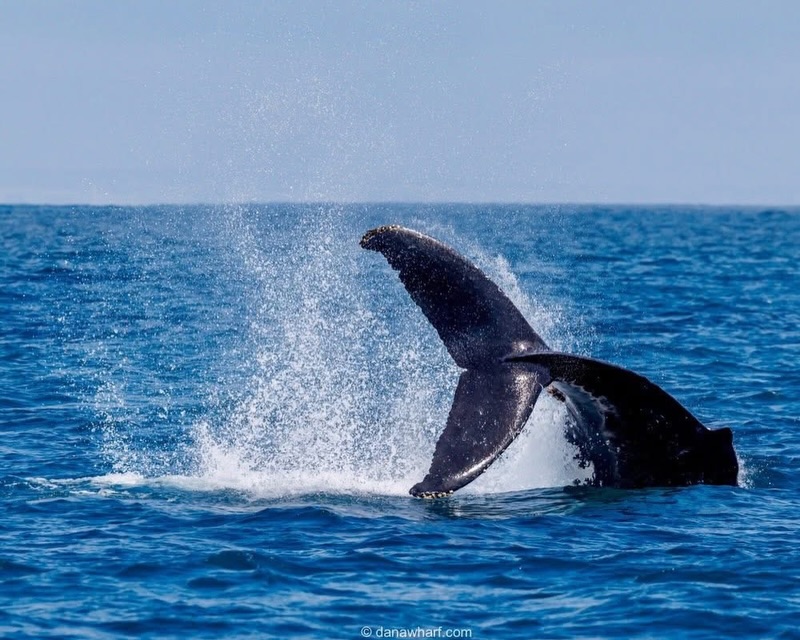
Spend enough mornings on the water off Dana Point and you start to get a feel for how a whale moves. Most of the time it is unhurried. A fin whale will surface, blow a tall column of mist, roll that long gray back through the swell, and slip under again, all at a pace that looks almost lazy. Then every once in a while something spooks it, or a pod of dolphins lights a fire under the whole scene, and you realize just how much power is sitting under that calm surface.
One of the questions we hear most on the bow is some version of “how fast can that thing actually go?” It is a fair thing to wonder when you are looking at an animal the length of a basketball court. The honest answer is that it depends on the species and on whether the whale is cruising or sprinting. So let us break it down the way we would on the rail, species by species, with the numbers that hold up.
How Fast Do Whales Swim, Really?
Here is the short version. Most of the big baleen whales we see off Southern California travel at a relaxed 3 to 9 miles per hour and cover long distances at around 5 mph. That is their everyday gear, the speed they use to migrate thousands of miles and to feed. When they need to, though, many of them can throw down a burst of 20 to 35 mph for a short stretch, usually to escape a threat or during a bit of social chaos.
The key idea is the difference between cruising speed and burst speed. A whale almost never swims at its top speed, the same way you do not sprint your morning walk. The cruising number is what you will see on a tour ninety-nine percent of the time. The burst number is the party trick you remember for the rest of your life if you happen to catch it.
How Fast Is a Blue Whale?
The blue whale is the largest animal that has ever lived on Earth, bigger than any dinosaur, reaching up to about 110 feet and 330,000 pounds. You would think something that size would be slow, and at a glance it is. According to NOAA Fisheries, blue whales typically swim around 5 miles per hour while they are feeding and traveling, but they can accelerate to more than 20 miles per hour in short bursts.
Think about that for a second. A creature heavier than a loaded semi truck can hit highway-on-ramp speed when it wants to. We are lucky enough to see blue whales feeding off Dana Point during the summer, roughly June through August, when they follow the krill blooms up our coast. If you want the full picture on just how staggering their size is, we went deep on it in our definitive guide to how big a blue whale really is.
What Is the Fastest Whale? Meet the Fin Whale
If you are asking which whale is the speed champion, the title among the great whales goes to the fin whale. Sailors and naturalists nicknamed it the “greyhound of the sea,” a phrase the American naturalist Roy Chapman Andrews used because its slender, racing-yacht body could outrun the steamships of his day. Fin whales sustain speeds around 23 to 25 mph and have been clocked in bursts closer to 30 mph, all while being the second-largest animal on the planet at 75 to 85 feet long.
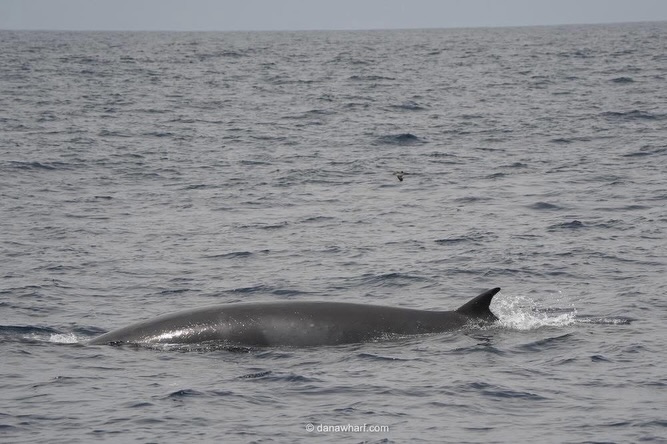
That speed comes from the build. NOAA describes the fin whale as having a sleek, streamlined body, and you can see it the moment one surfaces. The back goes on forever, smooth and tapered, with a small dorsal fin set far back. Fin whales are the bread and butter of our whale watching season off Dana Point, and they are honestly one of the most underrated animals out here. We covered the species in detail in our complete fin whale guide if you want to nerd out before your trip.
One footnote for the trivia crowd: some references clock the sei whale even faster than the fin whale in very short bursts, north of 30 mph. Sei whales are rare visitors here, so for practical Dana Point purposes the fin whale is the one to watch when you want to see real speed.
How Fast Can the Other Whales We See Off Dana Point Swim?
Speed is not the only way to be impressive, and our other regulars each move differently:
- Humpback whale: Humpbacks usually cruise around 3 to 9 mph and can burst to roughly 15 to 17 mph. What they lack in flat-out speed they make up for in acrobatics, which is why a humpback breach or tail throw is one of the best shows on the water. If they are your favorite, our ultimate guide to humpback whales has you covered.
- Gray whale: Gray whales are endurance athletes, not sprinters. They travel at a steady pace of about 5 mph, but they keep it up for one of the longest migrations of any mammal, roughly 10,000 miles round-trip and sometimes as far as 14,000, between the Arctic and Baja. Their season here runs through winter and early spring. We track the timing in our guide to the best time to see gray whales in Southern California.
- Minke whale: The smallest of our baleen whales is also one of the quickest, capable of around 20 to 24 mph. They are shy and hard to approach, and that speed is a big part of why.
Wait, Isn’t the Orca the Fastest?
This is where it gets fun. The orca, or killer whale, has been recorded in bursts up to about 34 mph, which makes it the fastest marine mammal in the ocean, faster than any of the true whales above. Here is the technicality: the orca is not actually a whale in the strict scientific sense. NOAA classifies it as the largest member of the dolphin family. We untangled that whole “is it a whale or a dolphin” question in a separate post on orcas, and it is a great rabbit hole.
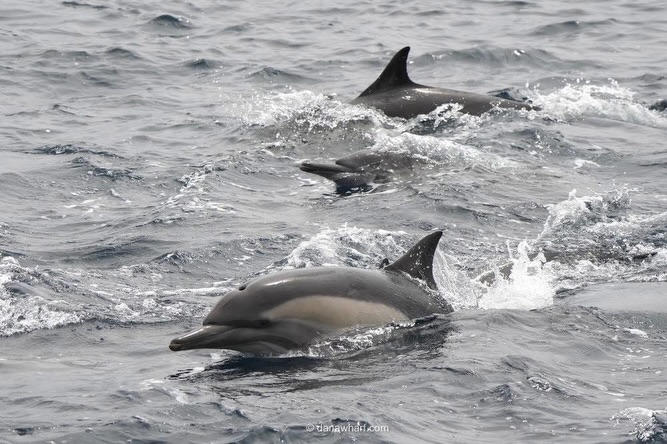
Their smaller cousins are no slouches either. The common dolphins that swarm our boats by the thousands can hit short bursts around 25 mph and love to surf the pressure wave off the bow. When a megapod decides to race you, it is pure speed and joy, and it is one of the most reliable thrills of a Dana Point trip. For the truly fast end of the ocean, our roundup of the fastest fish in the ocean puts these speeds in perspective. Spoiler: a few fish leave every whale and dolphin in their wake.
Why Don’t Whales Just Swim Fast All the Time?
If a fin whale can do 25 mph, why does it spend almost all day poking along at 5? The answer is energy. Moving a body that big through water is expensive, and the cost climbs steeply the faster you go. Baleen whales are built for efficiency over enormous distances, not for sprinting. Their cruising speed is the sweet spot that lets them migrate for months and lunge through clouds of krill and small fish without burning more fuel than they take in.
So a whale saves the high gears for when they matter: dodging a predator, jockeying during courtship, or the occasional burst of what sure looks like plain exuberance. The slow cruise is not laziness. It is the smartest way to run an engine that size.
Can You Outrun a Whale on a Whale Watching Boat?
Technically our boats can keep pace with a cruising whale all day, but that is not how we do it. We follow marine mammal viewing guidelines, which means we let the whales set the terms. We position the boat, cut the speed, and let the animals come and go on their own schedule. The best sightings happen when a curious fin whale or a relaxed humpback decides we are worth a look, not when anybody is chasing.
What that gets you off Dana Point is the full range of ocean speed in a single trip: a fin whale gliding past at a steady clip, a humpback throwing its tail in slow motion, and a megapod of common dolphins lighting up the bow wave at full tilt. If you have never seen it, come find out which one steals the show for you. Book a Dana Point whale watching tour with us, or catch a trip with our sister operation down the coast at Oceanside whale watching. The whales are out there right now, and summer is one of the best windows of the year to meet them.