
Dolphin vs Porpoise: What’s the Difference? (And What You’ll See Off Dana Point)
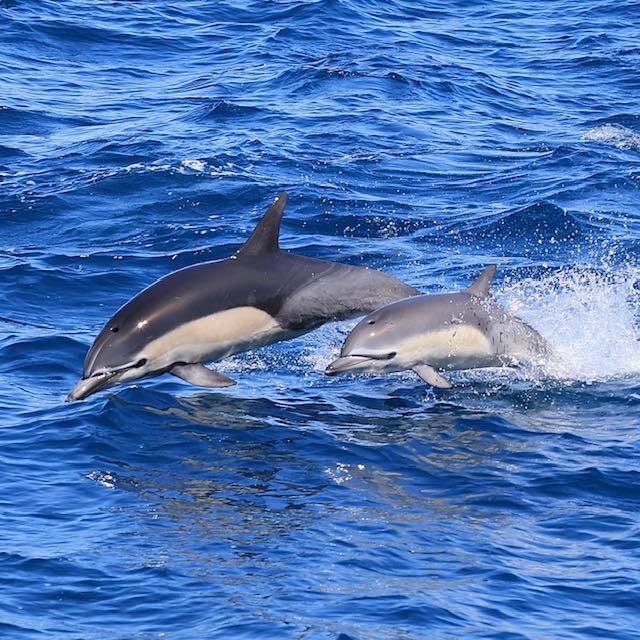
If you’ve been on a Dana Wharf whale watching trip, you’ve seen dolphins. Thousands of them. Megapods of common dolphins stretching across a mile of ocean. Bottlenose dolphins cruising past the harbor mouth. Pacific white-sided dolphins launching out of the water in the wake of the Dana Pride.
But have you ever seen a porpoise?
Probably not. And that surprises a lot of people, because most folks use “dolphin” and “porpoise” interchangeably. They assume they’re the same animal. They’re not. Dolphins and porpoises are different families of marine mammals with distinct physical features, behaviors, and personalities. And once you know what to look for, you’ll never mix them up again.
Are Dolphins and Porpoises the Same Animal?
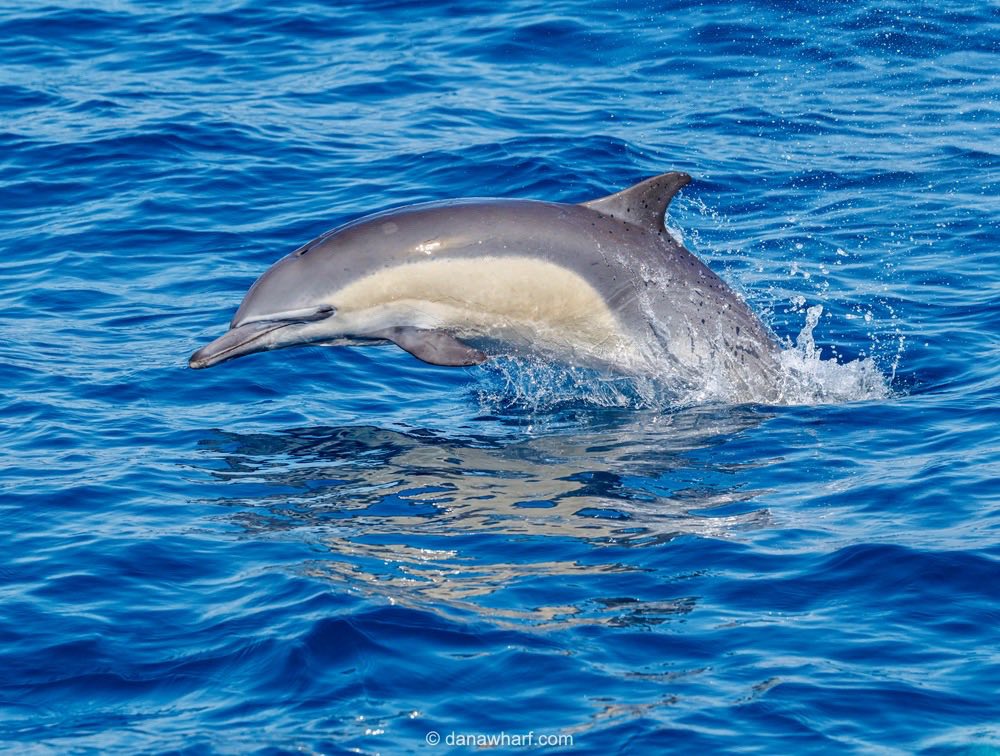
No. Dolphins and porpoises are both cetaceans (the order that includes all whales, dolphins, and porpoises) and they’re both classified as toothed whales. But that’s where the family reunion ends.
Dolphins belong to the family Delphinidae. There are about 33 species of oceanic dolphins, ranging from the 4-foot Maui’s dolphin to the 30-foot orca (which is technically the world’s largest dolphin, not a whale).
Porpoises belong to a completely separate family called Phocoenidae. There are only seven species of porpoise worldwide, and they’re actually more closely related to narwhals and belugas than they are to dolphins.
So calling a dolphin a porpoise is a bit like calling a fox a wolf. Same general category, but a very different animal.
How to Tell a Dolphin from a Porpoise
Here’s the cheat sheet our naturalists use when guests ask this question on the boat:
Face and beak. This is the most obvious difference. Dolphins have a pronounced, elongated snout that most people call a “beak.” It gives them that famous “smiling” look. Porpoises have shorter, rounder faces with no beak at all. If the animal looks like it has a nose, it’s a dolphin. If the face is flat and blunt, it’s a porpoise.
Teeth. If you ever get close enough to see the teeth (you probably won’t from a boat), they’re completely different. Dolphins have cone-shaped, pointed teeth designed for gripping slippery fish and squid. Porpoises have flat, spade-shaped teeth that look more like tiny shovels.
Dorsal fin. Dolphins have a curved, hook-shaped or sickle-shaped dorsal fin. Porpoises have a smaller, triangular dorsal fin. This is one of the easiest ways to tell them apart at a distance, especially when you only see a quick glimpse of the fin breaking the surface.
Body shape. Dolphins are generally longer and more streamlined. Porpoises are stockier and more compact. If you’re looking at a sleek, athletic-looking animal, it’s almost certainly a dolphin.
Size. Dolphins tend to be larger. Common dolphins off Dana Point average 6 to 8 feet. Bottlenose dolphins can reach 12 feet. The orca hits 30 feet. By comparison, most porpoise species max out around 5 to 7 feet. The vaquita, the world’s most endangered porpoise, barely reaches 5 feet.
Behavior: Why You See Dolphins But Rarely See Porpoises
This is where it gets really clear.
Dolphins are social, curious, vocal, and love boats. The common dolphins we see off Dana Point regularly ride our bow wave, leap in our wake, and sometimes swim alongside the boat for 20 minutes or more. They communicate using a complex system of whistles and clicks produced through their blowholes. They travel in pods that can number in the hundreds or even thousands. Our captains have seen megapods of over 2,000 common dolphins feeding and traveling together off the Dana Point headlands.
Porpoises are the opposite. They’re shy, elusive, and generally avoid boats. They tend to travel in small groups (sometimes just two or three animals) and stay below the surface most of the time. They don’t whistle like dolphins do. Scientists believe this may be due to structural differences in the porpoise blowhole. Instead, porpoises communicate using high-frequency clicks in the ultrasonic range, above what humans can hear.
The one exception is the Dall’s porpoise, a striking black-and-white species found in the North Pacific. Dall’s porpoises are famous for approaching boats and riding bow waves at high speed, creating a distinctive “rooster tail” of spray. They’re sometimes mistaken for baby orcas because of their coloring. But Dall’s porpoises are mainly found in colder waters from central California northward, and sightings off Dana Point are rare.
Which Dolphin Species Do We See Off Dana Point?
Dana Point has been officially designated the “Dolphin and Whale Watching Capital of the World,” and the dolphin part of that title is well earned. Here are the species our boats encounter regularly:
Long-beaked and short-beaked common dolphins. These are by far the most frequently sighted dolphins on our trips. They travel in enormous pods, sometimes exceeding 1,000 animals, and they’re incredibly acrobatic. On nearly every trip report from our naturalists, you’ll see common dolphins mentioned. They feed on anchovies, sardines, and squid in the productive waters off Dana Point.
Coastal bottlenose dolphins. Larger and more solidly built than common dolphins, bottlenose dolphins are often spotted closer to shore, sometimes right at the harbor mouth. Our captains see small pods of 5 to 20 coastal bottlenose dolphins cruising past the Dana Point headlands on a regular basis. These are the same species you’d recognize from aquariums and TV, but seeing them in the wild is a completely different experience.
Offshore bottlenose dolphins. A separate population of larger bottlenose dolphins lives farther from shore, usually beyond the continental shelf. They’re bigger than their coastal cousins and travel in larger groups. We encounter them on our longer trips and pelagic charters.
Pacific white-sided dolphins. These beautiful animals have a distinctive gray, white, and black color pattern and are known for their acrobatic leaps and flips. They’re more seasonal off Dana Point, typically showing up in cooler months, and they tend to travel in smaller pods than common dolphins.
Risso’s dolphins. Risso’s dolphins are unmistakable. Adults are covered in white scratches and scars from interactions with squid (their primary food source) and other Risso’s dolphins. They have a blunt head with no beak, a tall dorsal fin, and older individuals can appear almost entirely white. They’re less common than common or bottlenose dolphins off Dana Point but are always a special sighting.
Do Porpoises Live Off Dana Point?
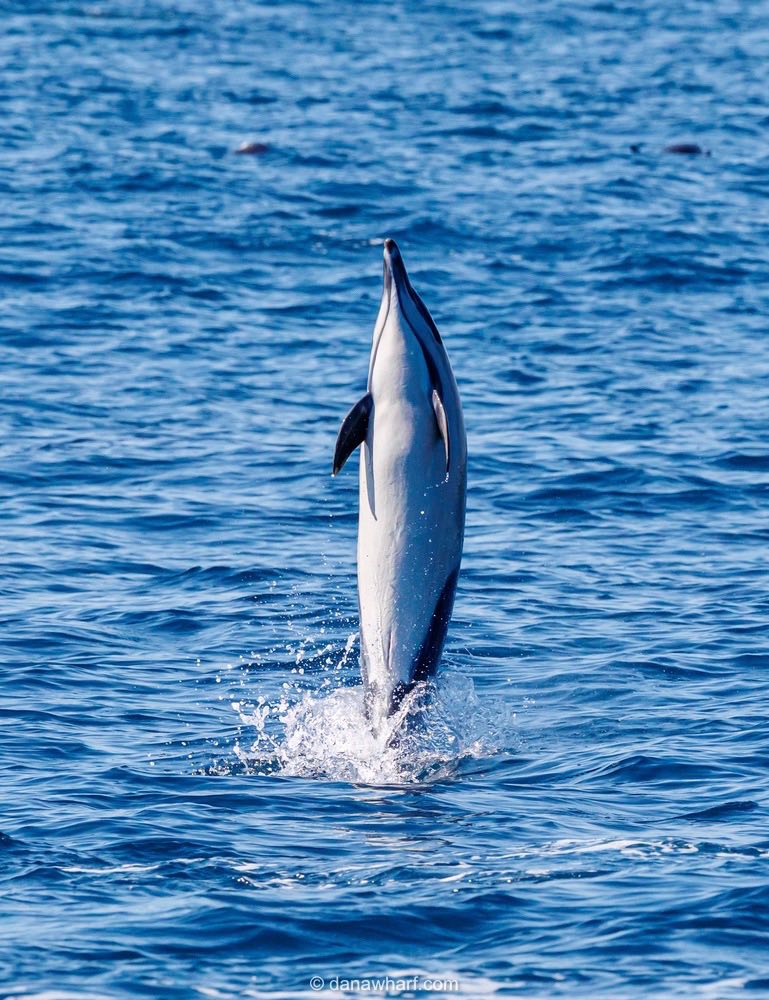
Technically, yes. The harbor porpoise (Phocoena phocoena) is found along the California coast, but they’re far more common in the colder waters of central and northern California. Sightings off Dana Point are uncommon. Dall’s porpoises are also present in California waters but primarily in the cooler regions from Monterey Bay northward.
The bottom line: if you see a small cetacean on a Dana Wharf trip, it’s almost certainly a dolphin, not a porpoise. And our naturalists can tell you exactly which species you’re looking at.
Why Does the Difference Matter?
Beyond the “fun fact” value, the distinction between dolphins and porpoises matters for conservation. Several porpoise species are critically endangered. The vaquita, found only in the northern Gulf of California, is the most endangered marine mammal on Earth, with fewer than 10 individuals believed to remain. Harbor porpoises face threats from fishing nets, pollution, and habitat loss throughout their range.
Dolphins face their own challenges. Bycatch, ocean noise pollution, chemical contamination, and climate-driven shifts in prey availability all affect dolphin populations. But because dolphins are more visible and more frequently encountered by humans, they tend to get more public attention and conservation funding.
Understanding that these are different animals with different needs helps researchers, conservationists, and policymakers protect both groups more effectively.
See Dana Point’s Dolphins for Yourself
On any given day at Dana Wharf, our whale watching boats encounter dolphins. It’s one of the most reliable wildlife experiences in Southern California. Whether it’s a pod of 50 bottlenose dolphins off the headlands or a megapod of 2,000 common dolphins stretching to the horizon, the dolphins off Dana Point never disappoint.
Now you’ll know exactly what you’re looking at, and you’ll know it’s not a porpoise.