
Do Jellyfish Have Brains? (No, and That’s Just the Beginning)
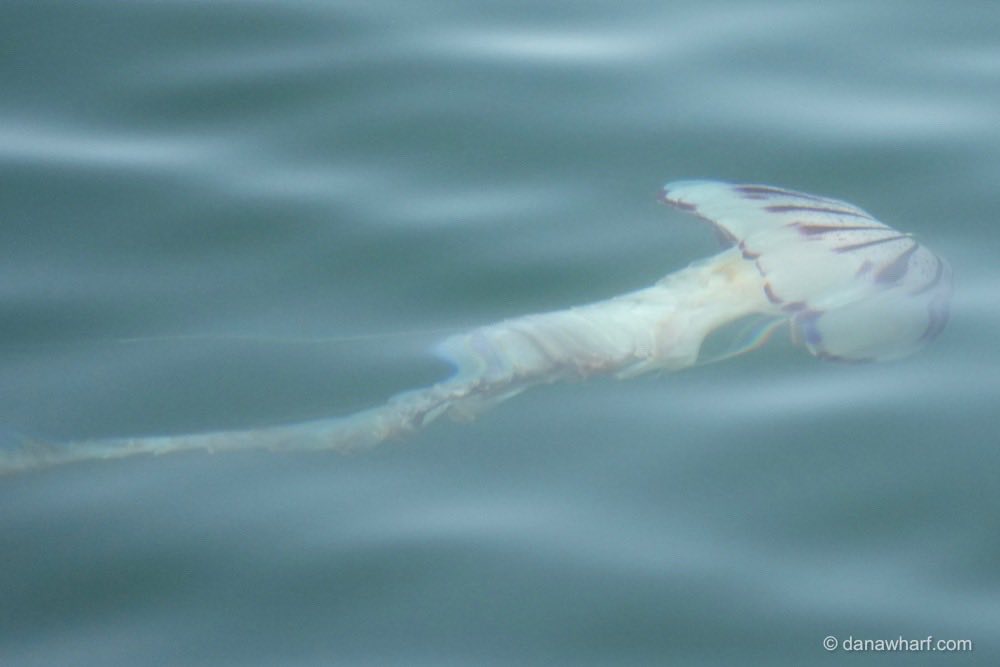
Every once in a while on a Dana Wharf trip, we’ll pass through a stretch of water dotted with jellyfish. Moon jellies drifting near the surface, their translucent bells pulsing slowly in the current. Pacific sea nettles trailing long amber tentacles behind them. Purple-striped jellyfish glowing like something from another planet.
They’re beautiful. They’re alien. And guests always ask the same question: do jellyfish have brains?
The answer is no. But honestly, that’s just the start of what’s strange about these animals. Jellyfish have no brain, no heart, no blood, no lungs, no bones, and no centralized nervous system. They’re roughly 95% water. And they’ve been thriving in the ocean for over 500 million years, making them one of the oldest animal groups on Earth.
Here’s how they pull it off.
No Brain. So How Do Jellyfish Think?
They don’t, at least not the way we understand thinking. Instead of a brain, jellyfish have what scientists call a nerve net. This is a web of interconnected nerve cells spread throughout the animal’s entire body. When part of the nerve net picks up a signal (a change in temperature, a touch, a shift in light), it transmits that information to the rest of the body, triggering a reflexive response.
Jellyfish actually have two separate nerve nets. A large nerve net controls swimming by coordinating the rhythmic pulsing of the bell. A smaller nerve net handles everything else, including feeding, contracting defensively, and moving tentacles to transport captured prey to the mouth.
Some jellyfish also have specialized sensory organs called rhopalia, small club-shaped structures distributed around the edge of the bell. Rhopalia can detect light, gravity, and chemical changes in the water. They help the jellyfish maintain balance and respond to environmental shifts.
The remarkable thing is that this decentralized system works. Jellyfish can hunt, feed, reproduce, migrate, and avoid threats, all without a single neuron reporting to a central command. If a chunk of a jellyfish’s bell is damaged or torn off, the rest of the animal keeps functioning normally. Try that with a brain.
Do Jellyfish Have Eyes?
Most jellyfish don’t have eyes in the way we think of them. They have light-sensitive spots called ocelli, located in or near the rhopalia, that detect the difference between light and dark. This gives them a blurry sense of their surroundings, enough to orient toward the surface or away from shadows.
The exception is box jellyfish. Box jellyfish have 24 eyes, some of which have lenses, corneas, and retinas capable of forming actual images. They can see objects, navigate around obstacles, and actively pursue prey. Box jellyfish are among the most venomous animals in the ocean, and having functional eyes makes them far more effective hunters than their drifting relatives.
Box jellyfish are tropical species found primarily in the Indo-Pacific. You won’t encounter them off Dana Point. The jellyfish species in Southern California waters rely on simpler light-sensing structures to navigate.
Do Jellyfish Have Hearts?
No. Jellyfish have no heart, no blood, and no circulatory system.
So how do their cells get oxygen? Through direct diffusion. The outer layer of a jellyfish’s body (the epidermis) is thin enough that oxygen from the surrounding seawater passes directly through the tissue and reaches the cells inside. Nutrients work the same way. There’s no pump needed because the jellyfish’s body is so thin and so saturated with water that everything it needs can diffuse in and out without any plumbing.
The “jelly” itself (the thick, gelatinous middle layer called mesoglea) is mostly water with some collagen and proteins mixed in. It serves as a flexible structural support and also stores oxygen. The whole design is brilliantly simple: build your body out of 95% water, keep the walls thin, and let the ocean do the work.
Do Jellyfish Feel Pain?
Almost certainly not in the way humans or other complex animals experience it. Jellyfish lack nociceptors, the specialized nerve receptors that detect potentially harmful stimuli and generate the sensation of pain in animals with more developed nervous systems. They also lack a centralized brain that could interpret nerve signals as “painful.”
That said, jellyfish do respond to harmful stimuli. If you try to cut a tentacle, a jellyfish will contract and swim away vigorously. Whether that’s “pain” or a simple reflexive response to tissue damage is a question scientists still debate. The honest answer is that we don’t fully know what a jellyfish experiences, but their nervous system doesn’t appear to have the architecture required for conscious pain perception.
Are Jellyfish Actually Fish?
No. Despite the name, jellyfish are not fish at all. They’re invertebrates in the phylum Cnidaria, the same group that includes corals, sea anemones, and hydra. They have no backbone, no scales, no gills (in the fish sense), and no swim bladder. They’re about as far from a fish as an animal can get while still living in the ocean.
The name “jellyfish” is a holdover from a time when anything that lived in the sea was loosely called a “fish.” Many scientists and aquariums now prefer the term “sea jelly” to avoid the confusion, though “jellyfish” remains far more commonly used.
How Do Jellyfish Sting Without a Brain?
Jellyfish sting through specialized cells called cnidocytes (also called nematocysts when referring to the actual stinging structures inside the cells). These are located primarily in the tentacles and, in some species, on the bell surface.
Each cnidocyte contains a coiled, harpoon-like structure loaded with venom. When triggered by physical contact or certain chemical signals, the nematocyst fires in microseconds, injecting venom into whatever touched it. This process is entirely mechanical and chemical. It doesn’t require a brain, a decision, or even a nerve signal. The cells fire on their own, which is why dead jellyfish washed up on the beach can still sting you.
The venom varies dramatically by species. Moon jellyfish stings are barely noticeable to most people. Pacific sea nettles produce a mild to moderate sting that can cause temporary pain and irritation. Box jellyfish, found in tropical waters (not off Dana Point), can deliver potentially fatal stings.
How Old Are Jellyfish as a Species?
Jellyfish fossils date back over 500 million years, and some researchers estimate they may have existed for more than 700 million years. That predates dinosaurs, sharks, insects, and trees. Jellyfish have survived all five of Earth’s mass extinction events, including the Permian-Triassic event that wiped out roughly 95% of all species.
Their secret is simplicity. With no complex organs to maintain, no bones to break, no specialized systems that can fail, jellyfish are extraordinarily resilient. Their body plan has barely changed over hundreds of millions of years because it works. The ocean rewards simplicity, and jellyfish are the proof.
There are an estimated 2,000 or more species of jellyfish alive today, found in every ocean on Earth, from tropical surface waters to the deep sea.
Jellyfish Off Dana Point
Several jellyfish species are found in the waters where Dana Wharf operates:
Moon jellyfish (Aurelia aurita) are the most commonly encountered species in Southern California. They’re translucent with four horseshoe-shaped reproductive organs visible through the bell, and their sting is so mild that most people don’t feel it at all. We see them frequently near the surface on calm days.
Pacific sea nettles (Chrysaora fuscescens) are the golden-brown jellyfish with long, flowing tentacles that show up in Southern California waters, particularly during warmer months. Their sting is noticeable but not dangerous. They’re one of the most photographed jellyfish species on the West Coast.
Purple-striped jellyfish (Chrysaora colorata) are native to the California Current and are one of the most visually striking jellyfish you’ll ever see. They have a silvery-white bell with vivid purple stripes radiating from the center. Sightings off Dana Point are less frequent but always memorable.
These jellyfish are also an important part of the food chain. The ocean sunfish (mola mola), which we see on our whale watching tours from time to time, feeds almost exclusively on jellyfish. Sea turtles, particularly leatherbacks, are also major jellyfish predators.
The Immortal Jellyfish
No jellyfish article is complete without mentioning Turritopsis dohrnii, the so-called “immortal jellyfish.” This tiny species (less than 5mm across) has the ability to revert from its adult medusa stage back to its juvenile polyp stage when stressed, injured, or aging. Essentially, it can restart its life cycle, potentially indefinitely.
This doesn’t mean it can’t die. Predation, disease, and environmental changes can still kill it. But the biological ability to reverse aging at the cellular level is unique in the animal kingdom and has made T. dohrnii one of the most studied organisms in aging research.
The immortal jellyfish is found in temperate and tropical waters worldwide. Whether individual specimens drift through the waters off Dana Point is unknown, but they’ve been documented in the Mediterranean, Atlantic, and Pacific.
See the Ocean’s Strangest Animals for Yourself
Jellyfish are just one piece of what makes the waters off Dana Point so incredible. On any given trip, you might see 2,000 dolphins, a breaching humpback, sea lions barking on the jetty, a mola mola the size of a dinner table, and a field of moon jellies drifting in the current. No two trips are ever the same.
The ocean is full of animals that break every rule we think we know about biology. Jellyfish have been doing it for half a billion years.
Book your next Dana Wharf adventure and see what’s out there.