
Can You Swim With Dolphins in California? (An Honest Answer from Dana Point)
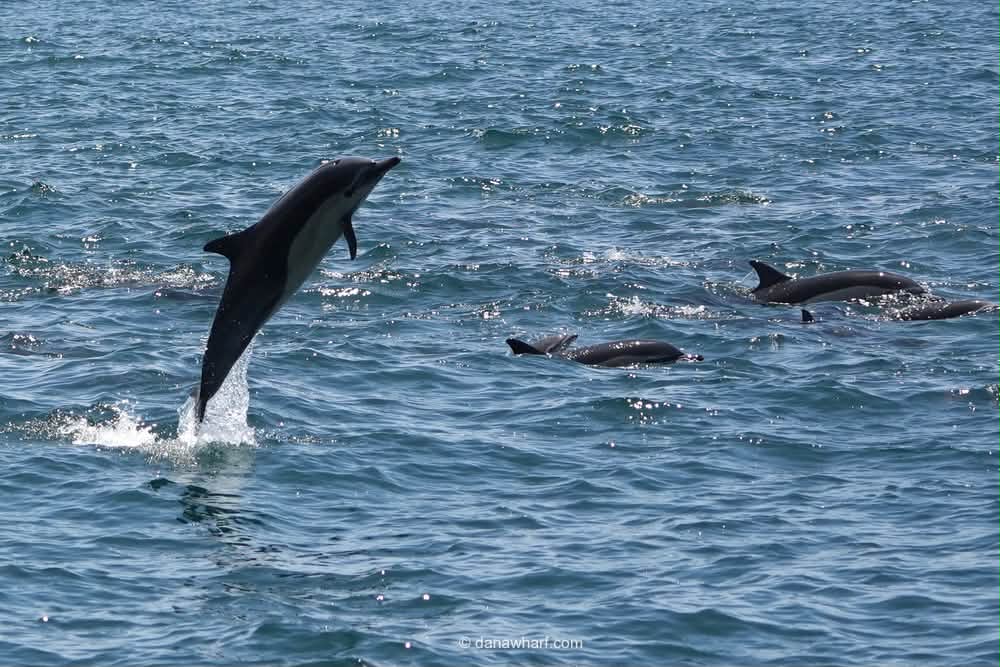
Every summer, somewhere between the second dolphin stampede and the third round of “did you SEE that,” a guest leans over the rail and asks me the same question: “Can we get in the water with them?” It is a fair thing to wonder. When a pod of common dolphins is riding your bow wave, close enough to hear them exhale, jumping in feels like the most natural idea in the world.
Here is the honest answer we give on the boat, and it surprises a lot of people. In California, you cannot legally swim with wild dolphins. Not on our trips, not on anyone’s, not off the end of the pier. And after 50-plus years of running boats out of Dana Point Harbor, we would not want you to. Let me explain why, what your options actually are, and why watching them wild off Dana Point beats any swim-with program you will find.
Can You Legally Swim With Wild Dolphins in California?
No. Deliberately swimming with, chasing, or crowding wild dolphins is considered “harassment” under the federal Marine Mammal Protection Act (MMPA), and harassment is illegal. The law makes it unlawful to “take” a marine mammal, and “take” covers a lot more than hunting. It includes any action that harasses, disturbs, or changes an animal’s natural behavior. Swimming out to a pod, feeding them, or trying to touch them all count.
The National Oceanic and Atmospheric Administration (NOAA) asks the public to stay at least 50 yards (about 150 feet) away from dolphins, porpoises, seals, and sea lions, and to never swim with, feed, or touch them. Penalties for harassing or feeding wild marine mammals run up to $100,000 in fines and as much as a year in jail per violation. Enforcement out on the open ocean is admittedly tough, and NOAA will tell you it is hard to prove who approached whom. But “hard to catch” is not the same as “allowed,” and it is not the point. The point is the animals.
Why Isn’t It Allowed? (And Why We’re Glad It Isn’t)
Wild dolphins are not the smiling cartoon version people picture. They are large, powerful, wide-ranging predators that hunt, socialize, rest, and raise calves on their own schedule. When a swimmer paddles into a pod, the dolphins have to react, and reacting burns energy they need for finding food and protecting their young. Mothers get separated from calves. Feeding stops. A single afternoon of “harmless” swimming, multiplied across a busy coastline, adds up to real stress on the population.
There is also the plain matter of safety. These are wild animals moving fast in open water where boats, currents, and other marine life come into play. Keeping a respectful distance protects them and you. Dana Point takes this seriously enough that in January 2021 the World Cetacean Alliance named it the first Whale Heritage Site in the Americas, a designation reserved for places where people and cetaceans genuinely coexist with respect. We are proud of that, and it shapes how we run every trip.
What About “Swim With Dolphins” Programs at a Park?
This is usually where the conversation goes next. The swim-with-dolphins experiences you see advertised are almost always captive programs at marine parks, not wild encounters. In California, a facility like SeaWorld San Diego operates under a separate federal permit and offers supervised, in-water interactions with trained bottlenose dolphins. That is legal because the setting is controlled and permitted, which is a very different thing from paddling out to a wild pod.
Whether a captive swim is right for you is a personal call, and we will let you make it. What we will say is this: a dolphin in a pool is behaving the way it has been trained to behave. A wild common dolphin exploding off your bow at 20 miles an hour, purely because it wants to, is behaving like a wild dolphin. One of those is a show. The other is the real ocean, and it is happening a few miles off our harbor almost every single day.
The Real Way to Experience Dolphins: See Them Wild Off Dana Point
You do not need to get in the water to have a close, unforgettable dolphin encounter. You need to get on the right boat in the right place, and few places on Earth are better than here. Dana Point brands itself the Dolphin and Whale Watching Capital of the World, and that is not just a slogan on a banner. Southern California holds one of the densest dolphin populations on the planet, with hundreds of thousands of dolphins living off this stretch of coast in nutrient-rich water that keeps them fed year-round.
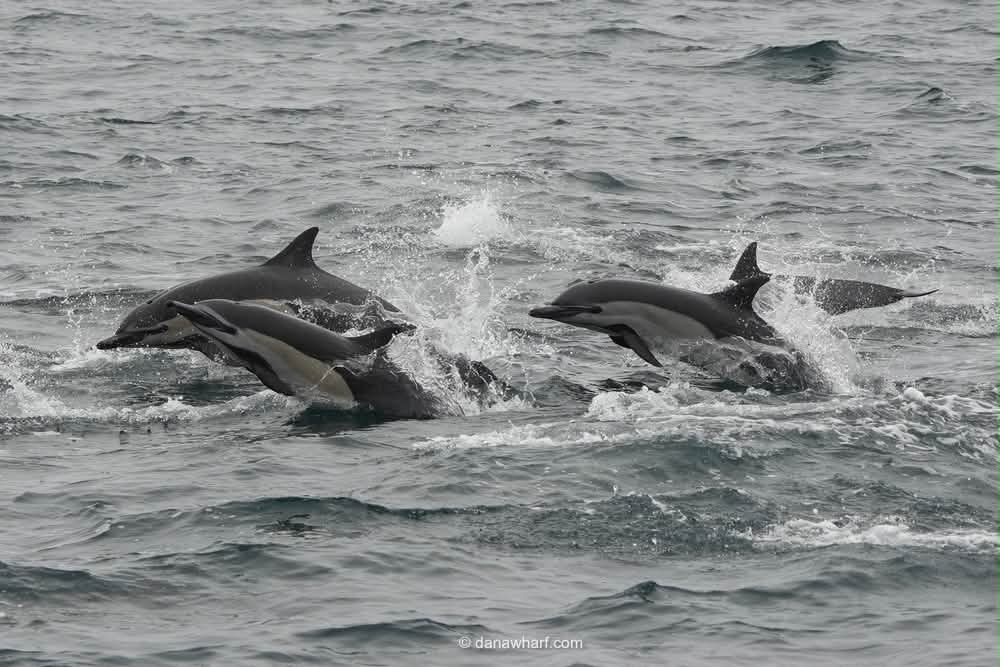
The showstopper is the megapod. On the best days we run into herds of common dolphins that can number into the thousands, and the biggest gatherings have been estimated near 10,000 animals stretched across the water for a mile. When a group that size decides to run, the whole ocean seems to boil. People who came hoping to spot a fin or two end up speechless, and no swim-with-dolphins pool on the planet can touch it. If you want the deeper story on those gatherings, we broke it down in our guide to dolphin megapods and when to see them.
Which Dolphins Will You See Off Dana Point?
Part of what makes this coast special is the variety. On a given trip you might see several species, each with its own personality:
- Common dolphins (short-beaked and long-beaked) are the crowd. They are the most abundant dolphin here, they do not migrate away, and they travel in those huge, fast-moving pods. If you see a stampede, it is almost always these.
- Bottlenose dolphins are the big, charismatic ones people recognize instantly. We see both a coastal group that hugs the shoreline and a larger offshore type further out.
- Pacific white-sided dolphins show up more in the cooler months, flashy and acrobatic with bold gray and white sides.
- Risso’s dolphins are the odd, wonderful ones, blunt-headed and covered in pale scars from a lifetime of squid hunting and social scuffles.
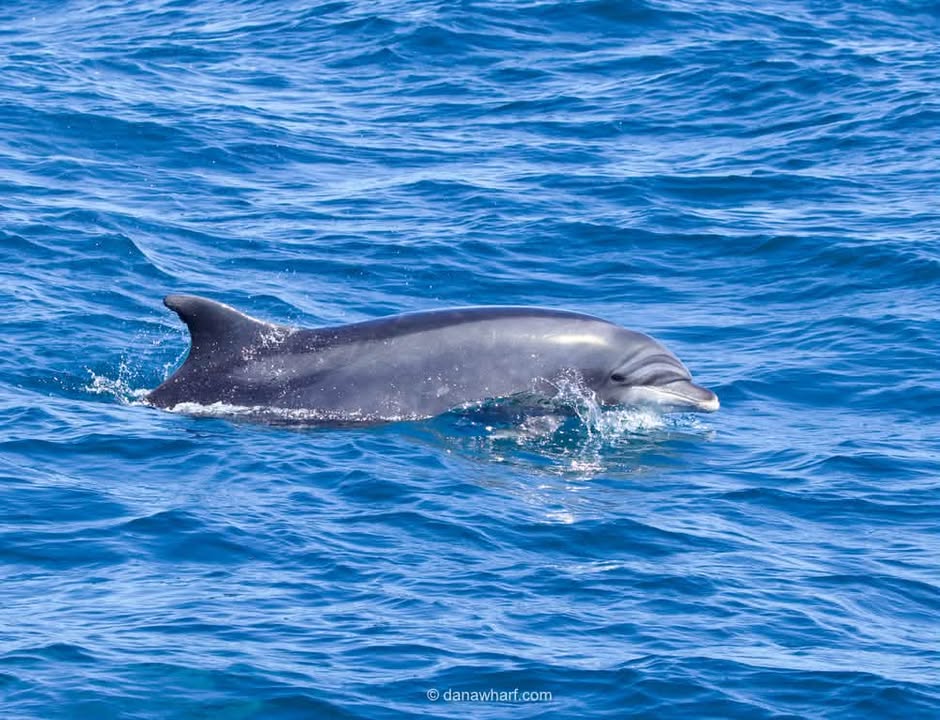
If you like knowing exactly what you are looking at, our field guide to the types of dolphins in Dana Point is worth a read before you come down. And if you have ever wondered just how sharp these animals are, the answer in how smart are dolphins is a big part of why we would rather watch them live their lives than pull them out of them.
How Close Do Wild Dolphins Actually Get? (Closer Than You Think)
Here is the part that makes the “can we swim with them” question almost funny once you have been out. You do not chase wild dolphins off Dana Point. They come to you. Common dolphins love to ride the pressure wave off the bow of a moving boat, surfing along inches from the hull, rolling sideways to look up at the faces hanging over the rail. It is called bow-riding, and it is entirely their idea.
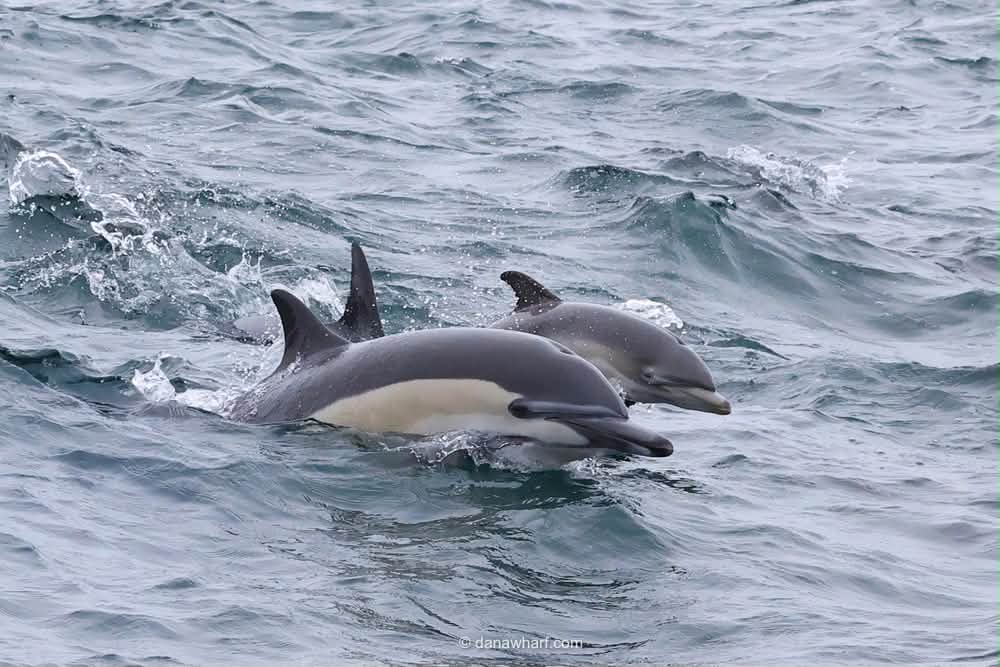
Sometimes a pod will surround the boat and just hang out, a moment we affectionately call getting “mugged.” You are not disturbing them and they are not performing. They are curious, they chose to be there, and you get to share the water on their terms. That is a better souvenir than any swim, and you stay warm and dry for it. Dolphins are out here most of the year, so your odds are excellent no matter the season. For the finer points on timing and where they tend to show, see our guide to whether there are always dolphins in Dana Point.
Planning Your Wild Dolphin Encounter
A few tips from the wheelhouse to make the most of it:
- Come any time of year, but summer is electric. The resident common dolphins are here in all seasons, and warm-water months tend to bring the biggest, most active megapods along with blue and fin whales.
- Bring a light layer and a camera. Even on a warm day it is cooler and breezier a few miles offshore. A zoom lens or a steady phone hand will catch the bow-riders beautifully.
- Kids love this trip. Dolphins are the reliable, high-energy sighting that keeps young first-timers glued to the rail from start to finish.
- Watch the water, not just the horizon. Dolphins often appear right alongside the boat, so keep your eyes moving.
So, can you swim with dolphins in California? Not the wild ones, and not with us. But you can stand at the rail of one of our boats while a thousand of them run past close enough to soak you, and honestly, that is the version worth having. Come see it for yourself on a Dana Wharf whale watching tour, or catch the same magic from our sister operation up the coast in Oceanside. The dolphins are already out there. All you have to do is show up.