Where to See California Sea Lions in Dana Point (And What Makes Them So Fascinating)
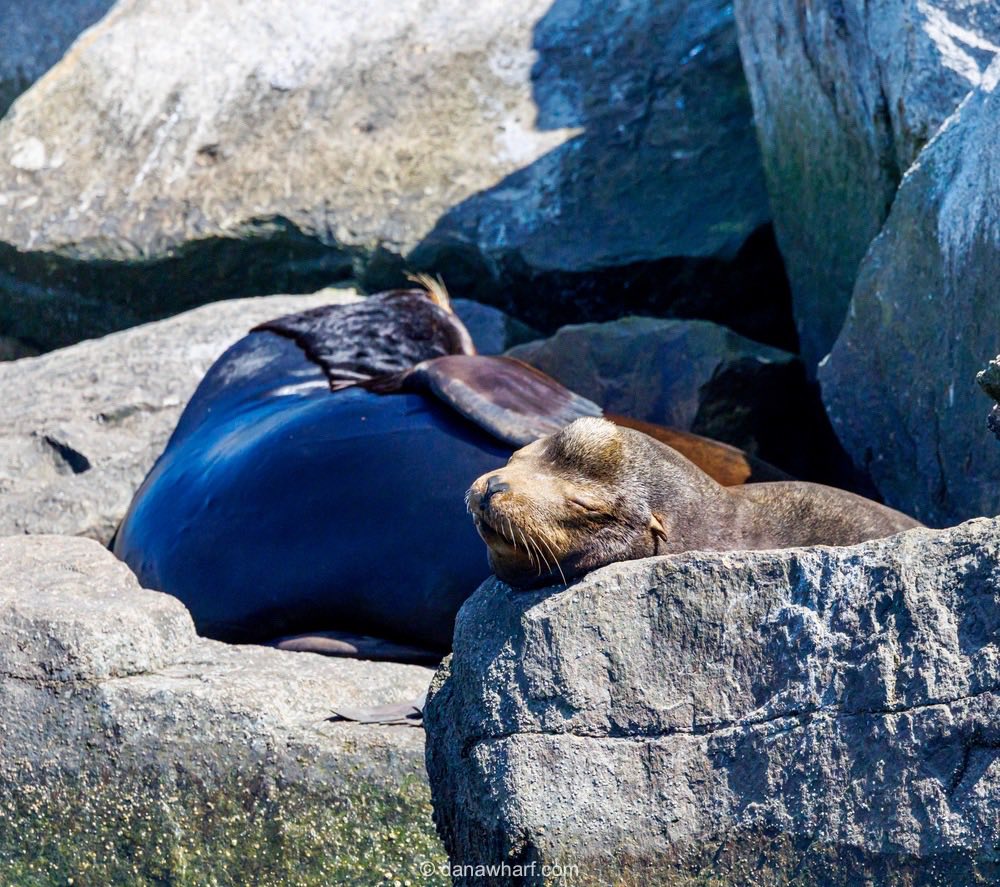
You hear them before you see them. That loud, rhythmic barking echoing across Dana Point Harbor is the unmistakable sound of California sea lions, and around here, it’s as constant as the Pacific itself. Walk down to Dana Wharf on any given morning, and you’ll spot them piled on the inner jetty rocks, draped over navigational buoys, and occasionally swimming lazy circles near the docks.
We see California sea lions on nearly every trip that leaves the harbor, whether it’s a whale watching cruise or a half-day sportfishing trip. They’re the welcoming committee. Sometimes they’ll follow the boats out past the breakwall, rolling and diving alongside us before peeling off to do their own thing. Other times, they’re content to stay hauled out in the sun, barely lifting a head as the Dana Pride or Clemente glide past.
Despite being one of the most visible marine mammals on the Southern California coast, a lot of people don’t know much about them beyond the barking. So here’s everything we’ve learned from watching these animals up close for over 55 years.
Where Can You See Sea Lions in Dana Point?
Dana Point Harbor is one of the most reliable places to see California sea lions in Orange County, and you don’t even need to get on a boat (though it helps). Here are the spots where we see them most consistently:
The inner harbor jetty. The rocks along the south jetty inside the harbor mouth are the most popular haul-out spot. On a calm day, you’ll see anywhere from a handful to 20 or more sea lions stacked up on the rocks, barking and jostling for position. It’s a scene that plays out every single day of the year.
Navigational buoys. The red and green navigational buoys near the harbor entrance are another favorite. Sea lions drape themselves over these buoys in the most improbable positions, flippers sticking out at odd angles, completely unbothered by boat traffic passing a few feet away.
Offshore. Once you’re out on the water with us, you’ll see sea lions feeding and traveling throughout the nearshore waters off Dana Point. They’re often mixed in with the same bait schools that attract dolphins and whales. During our whale watching tours, we regularly pass rafts of sea lions floating together at the surface, heads tucked under, flippers raised in the air in what marine biologists call “thermoregulating” (basically sunning their flippers to warm up or cool down).
Unlike many wildlife encounters that require timing and luck, sea lions in Dana Point are a guarantee. They’re here in January and they’re here in August. That predictability is part of what makes them such a great part of the experience for families and first-time visitors heading out from the wharf.
What’s the Difference Between a Sea Lion and a Seal?
This is one of the most common questions our naturalists get on board, and it’s a good one. People use “seal” and “sea lion” interchangeably, but they’re actually quite different animals.
Ears. The fastest way to tell them apart: sea lions have visible external ear flaps. True seals (like harbor seals, which also live in Dana Point) only have tiny ear holes with no external flap. That’s why sea lions are sometimes called “eared seals.”
Movement on land. Watch a sea lion on the jetty and you’ll see it use its large front flippers to “walk” around, rotating its hind flippers underneath its body. Seals can’t do this. They move on land by wriggling forward on their bellies, almost like a caterpillar. It’s a dead giveaway.
Noise. If you can hear it from across the harbor, it’s a sea lion. California sea lions are extremely vocal, producing that distinctive loud bark that carries hundreds of yards. Harbor seals, by contrast, are quiet animals that rarely vocalize beyond soft grunts.
Social behavior. Sea lions are gregarious. They pile on top of each other on the rocks, swim in groups, and seem to genuinely enjoy the company. Seals tend to be more solitary, especially in the water.
Both species live in and around Dana Point Harbor, so keep an eye out for the smaller, quieter harbor seals that occasionally pop up near the docks. But the big, noisy crowd on the jetty rocks? Those are your California sea lions.
What Do California Sea Lions Eat?
California sea lions are opportunistic feeders, and off Dana Point they eat many of the same species our sportfishing guests are targeting. Their diet includes anchovies, sardines, mackerel, rockfish, hake, market squid, and octopus. They’re not picky, and they’ll follow the food wherever it goes.
If you’ve ever been out on one of our fishing trips and noticed sea lions circling nearby, there’s a reason. They’re keyed into the same bait concentrations that attract yellowtail, calico bass, and barracuda. It’s a shared ecosystem, and the sea lions have a 10-million-year head start on figuring out where the fish are.
An adult male California sea lion can eat 35 to 50 pounds of food per day. Females eat less, roughly 10 to 25 pounds, but they increase their intake significantly during nursing season. That’s a lot of anchovies.
Their main predators off our coast are great white sharks and orcas, both of which we occasionally see on our whale watching trips. The relationship between orcas and sea lions is one of the most dramatic interactions in the marine world, and we’ve written more about it in our post on orcas vs. great white sharks.
How Deep Can California Sea Lions Dive?
This one surprises people. California sea lions can dive to depths of approximately 900 feet and hold their breath for nearly 10 minutes. That’s deeper than most recreational scuba certifications allow (130 feet) by a factor of seven.
Most of their dives are much shallower, averaging 66 to 164 feet deep and lasting under 3 minutes. But when they need to go deep, whether chasing squid into the water column or evading a predator, they have remarkable adaptations that make it possible.
Their lungs actually collapse at around 740 feet during descent, which prevents nitrogen from being absorbed into the blood (the same issue that causes “the bends” in human divers). As they ascend, the lungs re-expand at the same depth. They also slow their heart rate dramatically during deep dives, conserving oxygen for their brain and vital organs.
And they’re fast. California sea lions are the fastest pinnipeds (the group that includes seals, sea lions, and walruses) in the world. They can hit burst speeds of up to 25 miles per hour in the water, though their cruising speed is a more relaxed 6 to 7 mph. For reference, Olympic swimmer Michael Phelps tops out around 6 mph. These animals are built for the water in a way we can only watch and admire.
When Is Sea Lion Pupping Season in Southern California?
Most California sea lion pups are born in June, with the majority arriving in the first two weeks of the month. The primary breeding and pupping grounds are on the Channel Islands, particularly San Miguel, San Nicolas, and Santa Barbara Islands, all off the Southern California coast.
Females give birth to a single pup each year after a gestation period of about 11 months (with a 3-month delayed implantation, so the actual development time is closer to 8 months). Pups nurse for 6 to 12 months, and during that time, mothers alternate between feeding trips at sea and returning to the rookery to nurse.
Here in Dana Point, we start seeing more young sea lions in the harbor during late summer and fall as pups and juveniles from the Channel Islands begin dispersing along the coast. These younger animals are smaller and often more curious, sometimes approaching boats or popping up near the docks to investigate. Our naturalists on the whale watching tours can usually tell you which sea lions are juveniles based on their size and behavior.
The breeding season overlaps with pupping season, running from May through August. Males establish territories on the rookery beaches and compete aggressively for access to females. The peak of mating activity is late June through early July, just days after most pups are born.
Are California Sea Lions Endangered?
No, and that’s a genuine conservation success story. California sea lions are classified as Least Concern by the IUCN Red List. But it wasn’t always this way.
Before the Marine Mammal Protection Act was signed in 1972, California sea lion populations had been significantly reduced by hunting, habitat degradation, and other human pressures. In 1975, the U.S. population was estimated at fewer than 90,000 animals.
Since then, the population has recovered dramatically. It peaked at over 300,000 in 2012 before natural fluctuations (driven partly by El Nino events and changes in prey availability) caused some year-to-year variation. Today, the U.S. stock is estimated in the range of 250,000 to 300,000 animals, and NOAA considers the population to be at or near environmental carrying capacity.
That recovery is visible right here at the wharf. Old-timers who have worked at Dana Wharf for decades will tell you the sea lions are more abundant and more comfortable around people than they were 30 or 40 years ago. They’ve reclaimed the jetty, the buoys, and the harbor as their own, and honestly, it’s hard to imagine the place without them.
They’re still protected under federal law. It’s illegal to harass, feed, or approach California sea lions too closely, and we always remind our guests to observe from a respectful distance, especially when they’re hauled out and resting.
One More Thing the U.S. Navy Would Like You to Know
California sea lions are so intelligent and trainable that the U.S. Navy has used them in its Marine Mammal Program since the 1960s. Navy-trained sea lions can locate underwater mines, recover equipment from the ocean floor, and even detect unauthorized divers approaching military vessels.
Why sea lions? They’re faster swimmers than any human diver, they can see well in murky water, and they can be trained to perform precise tasks on command. The Navy’s MK 5 unit operates with sea lions, while MK 6 uses both sea lions and bottlenose dolphins (another species we see frequently off Dana Point, as we’ve covered in our 10 little-known facts about dolphins).
It’s a reminder that these animals hauled out on our jetty, the ones that look like they’re doing nothing more complicated than sunbathing, are among the most cognitively capable marine mammals in the ocean.
See California Sea Lions Up Close
Sea lions are part of every trip that leaves Dana Wharf. Whether you’re heading out for a whale watching cruise, a sportfishing adventure, or a private charter, you’ll see them in the harbor and out on the water. Book your trip today and say hi to the locals.